Home Organisation
How to Organise a Small Bedroom (With No Extra Space)
How to organise a small bedroom when you have no extra space. Vertical storage, furniture with storage, and decluttering strategies that actually work. 2026.
This post contains affiliate links. We may earn a commission at no extra cost to you.
How to Organise a Small Bedroom (With No Extra Space)
By Sarah Mitchell, Home Organisation Specialist | Last updated March 2026
The most common small bedroom organisation mistake is buying storage products before decluttering. The correct sequence is: remove what does not belong, purge what is unused, then add storage for what remains. A small bedroom can function beautifully with the right approach -- this guide gives you the systematic process and the best products for every step.
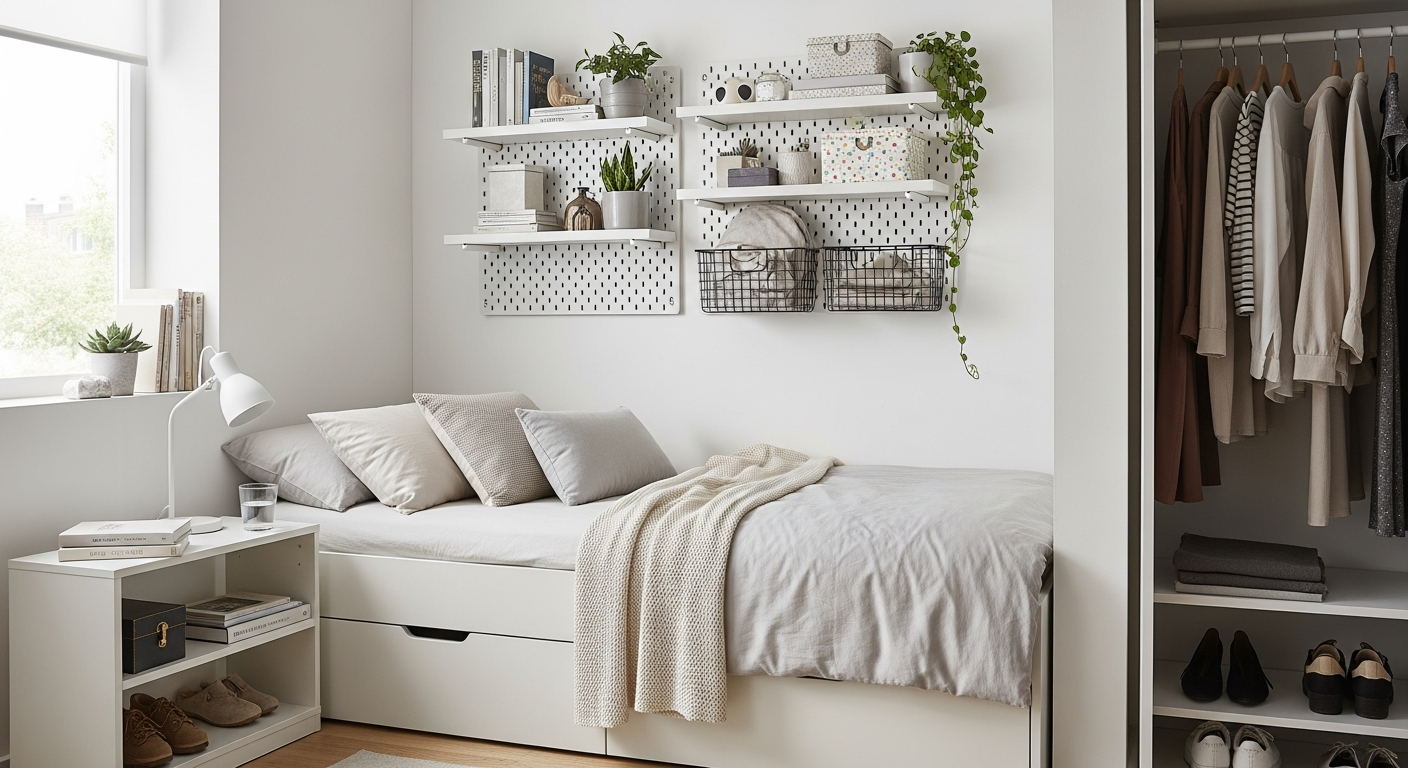
Table of Contents
- Phase 1: Purge First (Non-Negotiable)
- Phase 2: Vertical Storage Strategies
- Phase 3: Smart Furniture Choices
- Phase 4: Under-Bed and Hidden Storage
- Best Small Bedroom Organisation Products
- How Bedroom Organisation Affects Sleep
- Frequently Asked Questions
- Sources & Methodology
Phase 1: Purge First (Non-Negotiable)

The most storage products in the world cannot organise a cluttered bedroom. Purging must come first -- always.
The Bedroom-Only Rule
Your bedroom should contain only items that belong in a bedroom:
- Clothing and accessories
- Sleep-related items (bedding, pillows, sleep aids)
- Personal care items used daily
- Current reading material
- Minimal decor
Items that should leave the bedroom:
- Exercise equipment
- Work materials and laptop
- Books beyond current reading
- Hobby items stored out of convenience
- Clothes that do not fit or have not been worn in 12+ months
The Purging Process
Work category by category, not room by room. For clothing:
- Remove all clothing from wardrobe and drawers
- Pick up each item and assess: does this fit? Have I worn this in the last 12 months? Would I buy it again today?
- Items that fail any question go to donate/sell/discard piles
- Only return what passes
Target: Most people find they can reduce wardrobe volume by 30-50% through honest purging.
Phase 2: Vertical Storage Strategies

In a small bedroom, floor space is precious. Vertical space is almost always underutilised.
Floor-to-Ceiling Wardrobe Inserts
Standard wardrobes have a single hanging rail and nothing else. This wastes 60-70% of available space. Wardrobe inserts add:
- Double hanging rails (for shorter items like shirts and jackets)
- Shelving for folded items
- Drawer inserts
- Shoe racks
A $50-100 wardrobe insert can effectively double a standard wardrobe's capacity.
Floating Shelves Replace Furniture
A bedside table occupies 0.3-0.4m2 of floor space. Floating shelves occupy zero floor space. In a small bedroom, floating shelves at bedside height provide identical function (lamp, phone, book) while keeping the floor open.
Over-Door Organisers
The back of doors is universally wasted space in bedrooms. Over-door organisers with pockets hold:
- Shoes
- Accessories (belts, scarves)
- Books
- Toiletries
One over-door shoe organiser can hold 18-24 pairs of shoes in space that otherwise holds nothing.
Phase 3: Smart Furniture Choices
The Bed Frame Priority
Your bed is the largest piece of furniture in the bedroom and occupies the most floor space. Choosing a bed frame with integrated drawers converts dead space into functional storage. A queen bed frame with drawers provides 4-6 large drawers -- equivalent to a chest of drawers -- without any additional floor footprint.
Multipurpose Furniture
In a small bedroom, every piece of furniture should serve at least two purposes:
- Ottoman with storage (seating + storage)
- Mirror wardrobe doors (opens the room visually + mirrors)
- Nightstand with drawers (surface + storage)
Phase 4: Under-Bed and Hidden Storage

The space under the bed is prime real estate. In a double bed, this space can hold:
- 3-4 seasons of seasonal clothing
- Extra bedding and pillows
- Sports equipment not used daily
For visible organisation: Use uniform, labelled storage boxes rather than plastic bags or miscellaneous containers.
For maximum capacity: Vacuum storage bags compress bulky items (duvets, winter coats, extra pillows) to 1/3 of their original size.
The organisation link: How your bedroom environment is set up significantly influences sleep quality. A clutter-free, well-organised bedroom creates the calm environment associated with better sleep -- the visual order reduces cortisol and prepares the brain for sleep.
Best Small Bedroom Organisation Products


<video autoPlay muted loop playsInline poster="/images/articles/organise-small-bedroom-thumb.jpg" style={{width:"100%",borderRadius:"8px",margin:"1.5rem 0"}}>
How Bedroom Organisation Affects Sleep

Research confirms that bedroom clutter impairs sleep quality. A 2015 study in Sleep found that bedroom clutter was associated with higher cortisol levels in the hour before sleep -- which delays sleep onset and reduces sleep quality.
The mechanism: visual disorder activates the prefrontal cortex (the planning and problem-solving brain region), preventing the deactivation needed for sleep onset. A clear, organised bedroom is literally easier to sleep in.
Practical minimums for sleep-supporting bedroom organisation:
- Cleared bedside surfaces (phone charging elsewhere if possible)
- No visible work materials
- Clear floor path from bed to door
- Clothing stored away (not draped over chairs or floor)
For more on the sleep-bedroom environment connection, see bedroom environment for better sleep for research-backed guidance on environmental factors beyond organisation.
Maintaining the System Long-Term
Organisation systems fail because maintenance is not built into the routine. For a small bedroom, two habits maintain the system:
The daily reset (3 minutes): Each morning or evening, return everything to its designated place. This prevents accumulation that requires a major reorganisation every few months.
The seasonal review (30 minutes, every 3-4 months): Check under-bed storage, rotate seasonal clothing, identify anything new that has entered the bedroom without a home.
For related organisation guides, see our articles on best home organisation products 2026, best closet organiser systems, and best under-bed storage 2026.
Frequently Asked Questions
How do you organize a really small bedroom? Purge first (remove items that don't belong), then add vertical storage, choose furniture with built-in storage, and use under-bed space for seasonal items.
What should not be in a small bedroom? Exercise equipment, work materials, excess books, clothes that don't fit, and anything not used regularly.
What is the best storage for a small bedroom? Bed frame with drawers (highest impact), wardrobe insert (doubles capacity), floating shelves (floor-free bedside), under-bed rolling drawers.
Sources & Methodology
- Roster C, Ferrari JR, Jurkat MP (2016). The dark side of home: assessing possession "clutter" on subjective wellbeing. Journal of Environmental Psychology, 46.
- Cortisol and clutter study: Saxbe D, Repetti R. (2010). No place like home: Home tours correlate with daily patterns of mood and cortisol. Personality and Social Psychology Bulletin.
- National Sleep Foundation. Bedroom environment guidelines for sleep quality.
- Marie Kondo (2014). The Life-Changing Magic of Tidying Up. Ten Speed Press.
Room-Specific Organisation Tips for Small Bedrooms
When You Share a Small Bedroom
Shared small bedrooms need clear spatial boundaries. Each person should have their own wardrobe section, drawer allocation, and bedside area. Shared spaces (under the bed, additional storage) should have clear assignments.
Regular check-ins about storage allocation prevent gradual drift where one partner's belongings expand into the other's space. The organisation system should work equally well for both occupants.
Studio Apartments: Bedroom-Living Hybrid Spaces
When the bedroom is also the living area, division through furniture placement creates psychological separation. A bookshelf or room divider between sleeping and living areas helps maintain sleep associations for the sleeping zone.
Keep the sleeping zone strictly clear of work items, entertainment, and anything that activates rather than relaxes.
Sarah Mitchell is a Home Organisation Specialist with 12 years of experience helping clients in small-space living situations. She holds certification from the Association of Professional Declutterers and Organisers.
Creating a Bedroom Inventory System
One underrated approach for small bedroom management: a simple bedroom inventory. This is especially useful for shared bedrooms, rental situations, or people who struggle with accumulation.
What to inventory: All items in the bedroom by category (clothing by type, books, personal items, equipment). A simple spreadsheet or even a paper list works.
Why it helps: Seeing the full count of items in a category (28 t-shirts) makes purging decisions easier. Without the count, it's hard to judge whether you "have enough" of something. With the count, the decision becomes clear.
Seasonal inventory update: At the start of each season, review the inventory and identify items to retire. This prevents the gradual accumulation that makes small bedrooms feel overwhelming.
The One-In, One-Out Rule
For small bedrooms, the one-in, one-out rule is essential for long-term organisation:
- When a new clothing item enters the bedroom, one existing item leaves
- When a new book enters, one book leaves
- When a new decor item is added, an existing item is removed
This rule eliminates the growth of bedroom inventory over time and maintains the storage systems you implement.
Digital Minimalism in the Bedroom
One often-overlooked bedroom organisation issue is digital devices. Phones, tablets, chargers, cables, and tech accessories create clutter and affect sleep quality.
Recommendation: Designate a single charging spot outside the bedroom (charging station in hallway or living room). Keep only the minimum necessary technology in the bedroom. This simultaneously reduces visual clutter and improves sleep quality by removing the sleep-disrupting stimuli.
For full home organisation guidance beyond the bedroom, see our guides on best kitchen cabinet organizers, best closet organiser systems, and best home organisation products 2026.
A well-organised bedroom sets the foundation for a calm, restorative living space.
A calm, organised bedroom is one of the highest-impact environments you can create for your daily wellbeing, sleep quality, and overall mental health. Even modest improvements -- cleared surfaces, orderly wardrobe, defined storage -- produce measurable improvements in how the space feels and functions. Small consistent actions -- the daily 3-minute reset, seasonal reviews, one-in-one-out -- compound over time into a bedroom that stays organised without constant effort.