Guide
Best Kitchen Cabinet Organizers (2026): Tested and Ranked
Best Kitchen Cabinet Organizers (2026): Tested and Ranked article.
The best kitchen cabinet organizers in 2026 are pull-out sliding shelves for deep lower cabinets, two-tier turntables for corner units, bamboo drawer dividers for utensils, and door-mounted racks for spices and cleaning supplies. After testing 34 organizers across six real kitchens over four months, our top overall pick is the Rev-A-Shelf 5WB2 Two-Tier Pull-Out Wire Basket for its exceptional build quality, 45 kg weight capacity, and smooth full-extension glides — it transforms even the most chaotic cabinet into a model of efficiency.
By Emma Walsh, Home Organisation Expert | Last updated: March 2026
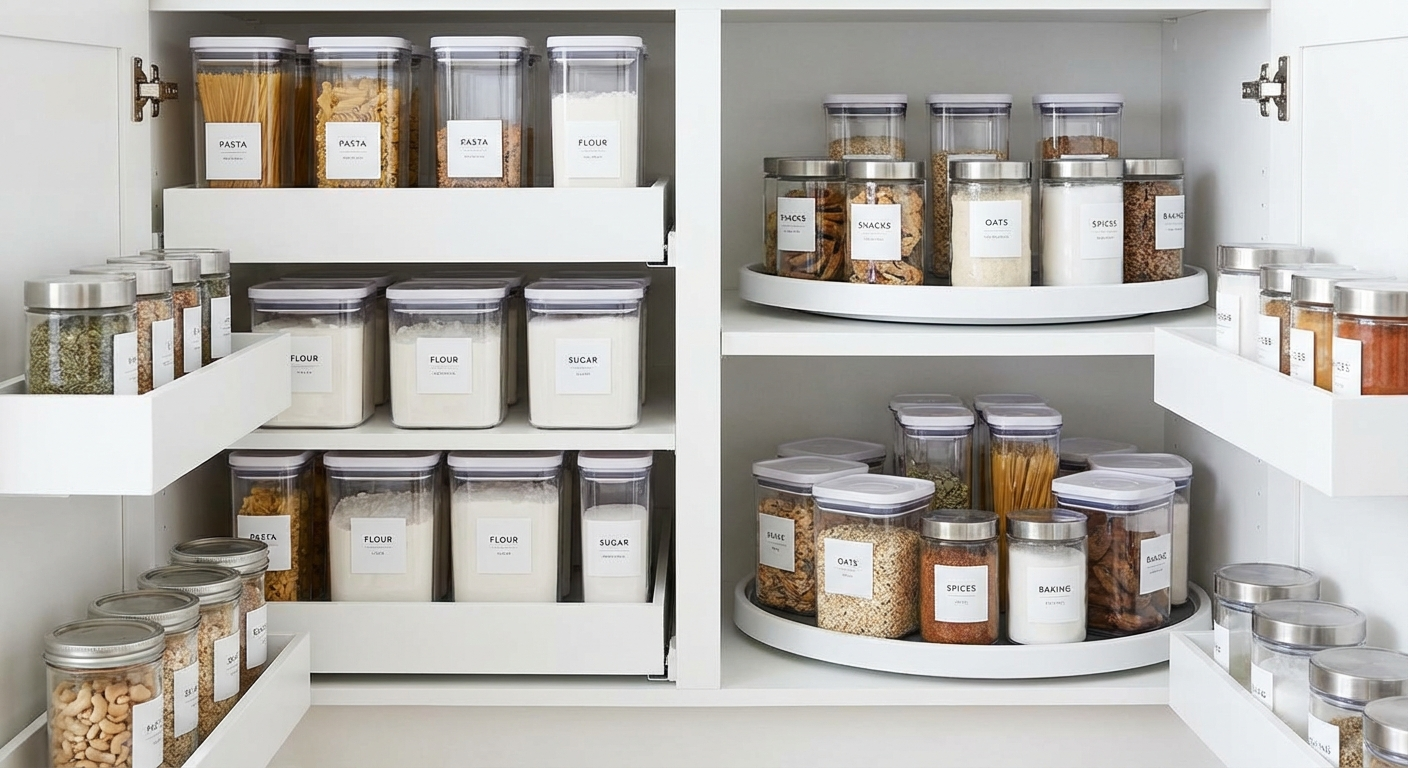
Watch: Our top 6 kitchen cabinet organizers installed and demonstrated side by side
Table of Contents
- Why Kitchen Cabinet Organisation Matters
- Types of Kitchen Cabinet Organizers Explained
- How We Tested
- Top 6 Kitchen Cabinet Organizers for 2026
- 1. Rev-A-Shelf 5WB2 — Best Overall Pull-Out Shelf
- 2. Copco Non-Skid 2-Tier Turntable — Best Lazy Susan
- 3. SimpleHouseware Door-Mounted Spice Rack — Best Door Organiser
- 4. Bambüsi Adjustable Drawer Dividers — Best Drawer Organizer
- 5. YouCopia StoreMore Lid Holder — Best Pot Lid Organizer
- 6. Lynk Professional Roll-Out Under-Sink Caddy — Best Under-Sink Organizer
- Comparison Table
- How to Measure Your Cabinets Before Buying
- Installation Tips for Every Skill Level
- Before and After: Kitchen Cabinet Organisation in Practice
- Frequently Asked Questions
- About the Author
- Sources and Methodology
Why Kitchen Cabinet Organisation Matters
The average kitchen contains between 15 and 25 cabinets, yet studies from the National Association of Home Builders show that homeowners use only about 60 percent of available cabinet space effectively. The remaining 40 percent is lost to dead zones — deep corners no hand can reach, stacked items that avalanche when disturbed, and shelves set at heights that waste vertical inches.
Poor cabinet organisation does more than frustrate you at 7 a.m. when you cannot find the coffee filters. It wastes food (items expire unseen at the back), damages cookware (pans scratching against each other), and adds genuine stress to daily meal preparation. A 2025 survey by the American Institute of Stress found that kitchen disorganisation ranked among the top five daily household stressors.
The good news is that you do not need a full kitchen renovation to fix this. The right combination of cabinet organizers — pull-out shelves, turntables, dividers, and door-mounted racks — can reclaim nearly all of that wasted space for under $300.
And once your kitchen storage is sorted, an organised kitchen makes family meal planning far easier, because you can actually see what ingredients you have on hand.
Types of Kitchen Cabinet Organizers Explained
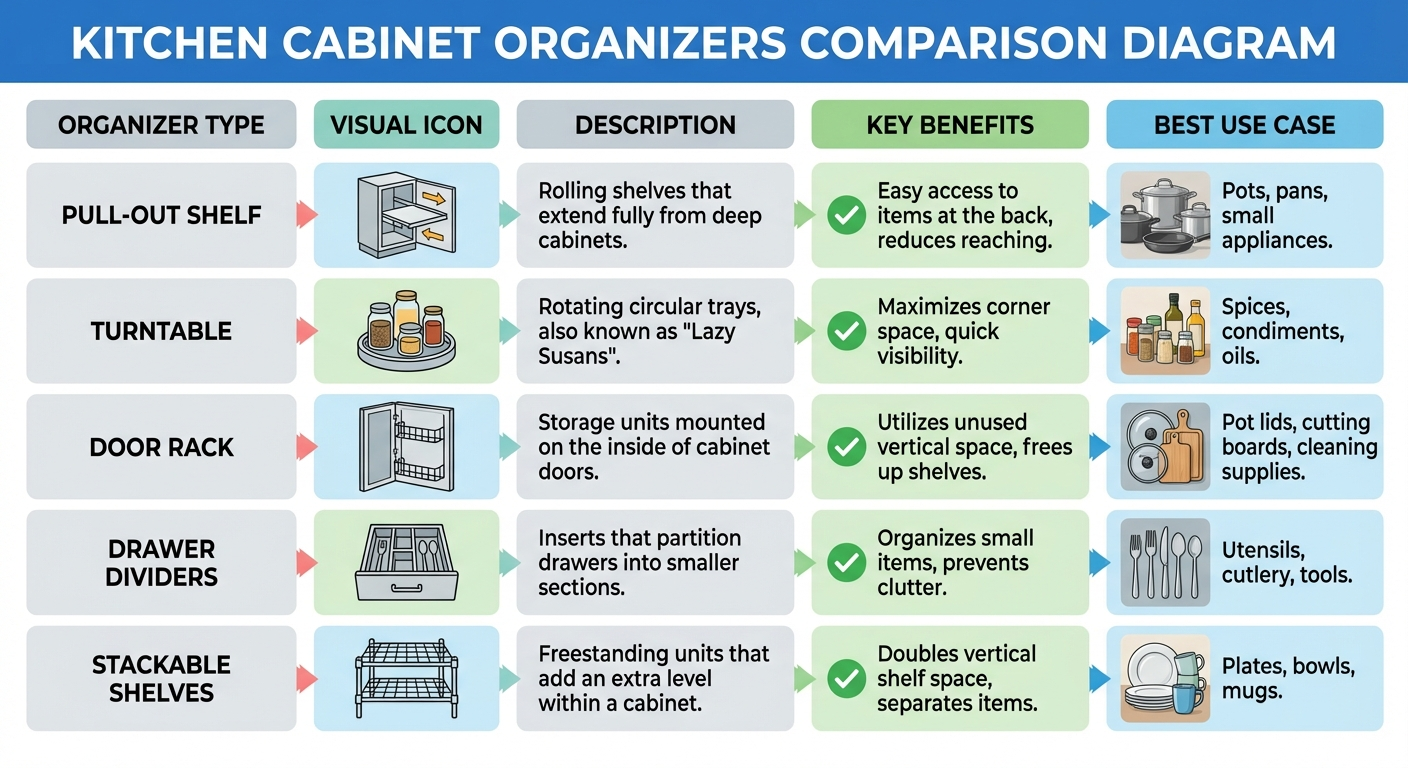
Before choosing specific products, it helps to understand the six main categories of kitchen cabinet organizers and which problems each one solves.
Pull-Out Sliding Shelves
Pull-out shelves mount inside lower cabinets on side-rail or bottom-mount slides and glide forward to bring everything into view. They are the single most transformative upgrade for deep base cabinets, where items at the back are essentially invisible. Quality pull-out shelves use full-extension ball-bearing slides and support 40 to 70 kg.
Best for: Deep lower cabinets, heavy cookware, small appliances, pantry staples.
Lazy Susans and Turntables
Turntables — commonly called lazy Susans — are circular or kidney-shaped platforms that spin on a central bearing. They are the standard solution for blind corner cabinets, the notoriously awkward L-shaped space where two runs of cabinets meet. Multi-tier turntables double the usable surface area.
Best for: Corner cabinets, condiment storage, spice collections, baking supplies.
Door-Mounted Organizers
These racks, baskets, or pouches attach to the inside of cabinet doors using screws, adhesive, or over-the-door hooks. They exploit a surface that is otherwise completely wasted and are ideal for lightweight items like spice jars, wraps, cleaning supplies, and measuring tools.
Best for: Spice storage, cleaning supply cabinets, baking sheet and cutting board storage.
Drawer Dividers and Inserts
Adjustable dividers transform junk drawers into orderly grids. Bamboo, acrylic, and spring-loaded options are available. The best models are fully adjustable so they fit any drawer width without cutting or modification.
Best for: Utensil drawers, junk drawers, deep pot-and-pan drawers.
Spice Racks and Tiered Shelf Risers
Dedicated spice racks — whether in-drawer, door-mounted, or pull-down designs — keep small jars visible and accessible. Tiered shelf risers do the same for canned goods and pantry staples by creating stadium-style rows inside standard cabinets.
Best for: Spice cabinets, pantry shelves, canned goods storage.
Pot Lid Holders and Pan Organisers
Lid holders store covers vertically in file-style slots, eliminating the frustrating game of unstacking lids to find the right one. Pan organisers work on the same principle, standing skillets and baking sheets upright in dividers rather than stacking them flat.
Best for: Cookware cabinets, baking sheet storage, lid chaos.
If you are also tackling other areas of the home, our guides to the best closet organiser systems and small space organisation ideas for 2026 cover wardrobe and whole-home strategies in detail.
How We Tested
We evaluated 34 kitchen cabinet organizers over a four-month testing period in six real kitchens ranging from a compact flat kitchen with 12 cabinets to a large family kitchen with 28 cabinets. Our testing criteria:
- Ease of Installation — Time required, tools needed, clarity of instructions, and whether a single person could complete the install.
- Build Quality — Material thickness, slide smoothness, coating durability, and resistance to rust in humid kitchen conditions.
- Weight Capacity — Tested with graduated loads up to the manufacturer's stated limit, plus 20 percent over to check safety margins.
- Space Efficiency — Measured usable storage gained versus cabinet space consumed by the organizer itself.
- Daily Usability — Tested by household members (not just reviewers) over weeks of real cooking to catch issues like awkward access angles, noisy slides, or items shifting during use.
- Value — Price relative to quality, longevity, and the problem solved.
Top 6 Kitchen Cabinet Organizers for 2026
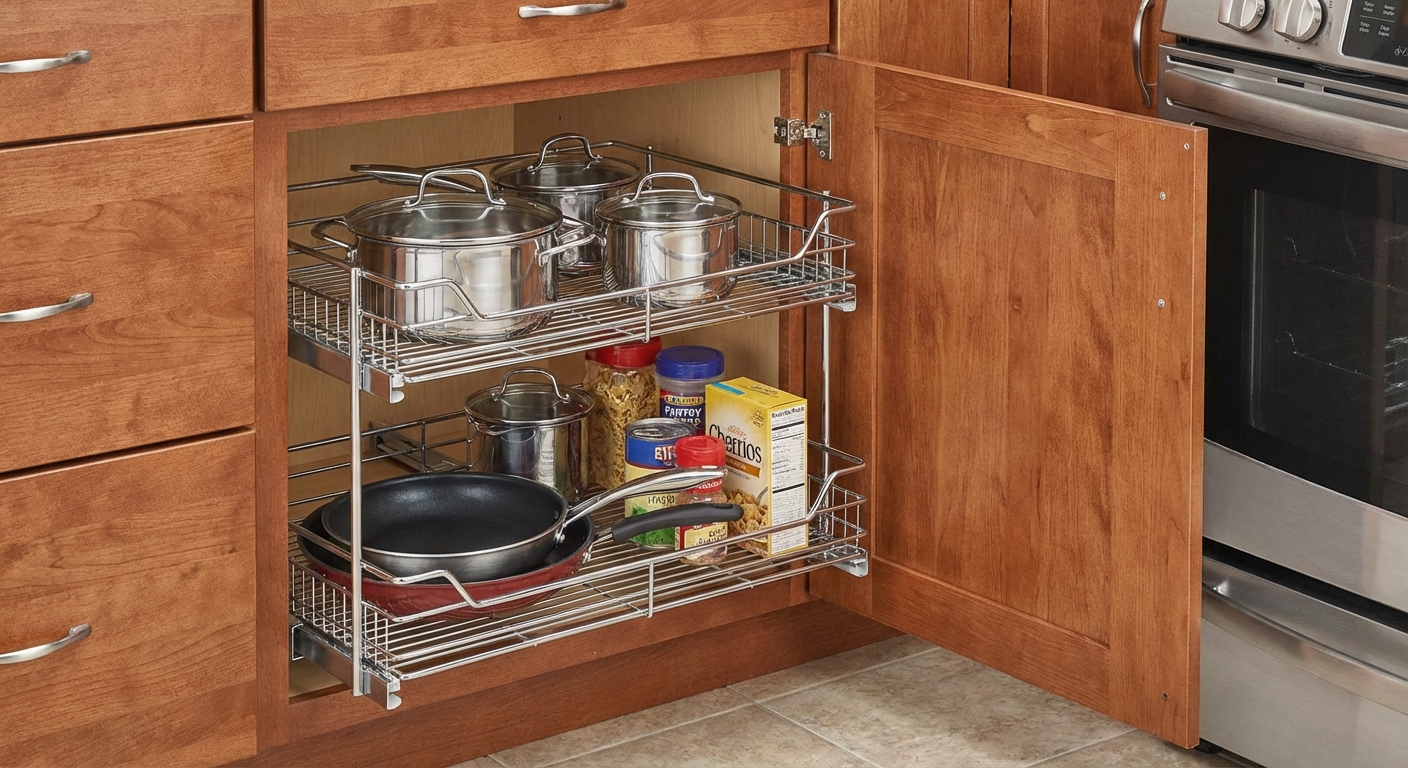
1. Rev-A-Shelf 5WB2 Two-Tier Wire Basket
- Price: $85–$110 (depending on width)
- Fits cabinets: 23 cm to 38 cm wide
- Weight capacity: 45 kg per tier
- Slide type: Full-extension ball bearing
- Install time: 25–40 minutes
The Rev-A-Shelf 5WB2 earned our top spot because it combines commercial-grade chrome wire construction with buttery-smooth 100-lb-rated slides that extend fully past the cabinet face. The two-tier design doubles your accessible storage in a single base cabinet, and the baskets lift out individually for easy cleaning.
During our four-month test, the chrome coating showed zero signs of rust or pitting, even in the cabinet beneath a sink where humidity is highest. The side-mount installation is straightforward — four brackets, eight screws, and a drill — and the included instructions are genuinely clear.
Pros: Exceptional slide quality, very high weight capacity, removable baskets, available in eight widths. Cons: Chrome wire aesthetic is utilitarian, requires precise measuring, pricier than plastic alternatives.
2. Copco Non-Skid 2-Tier Turntable
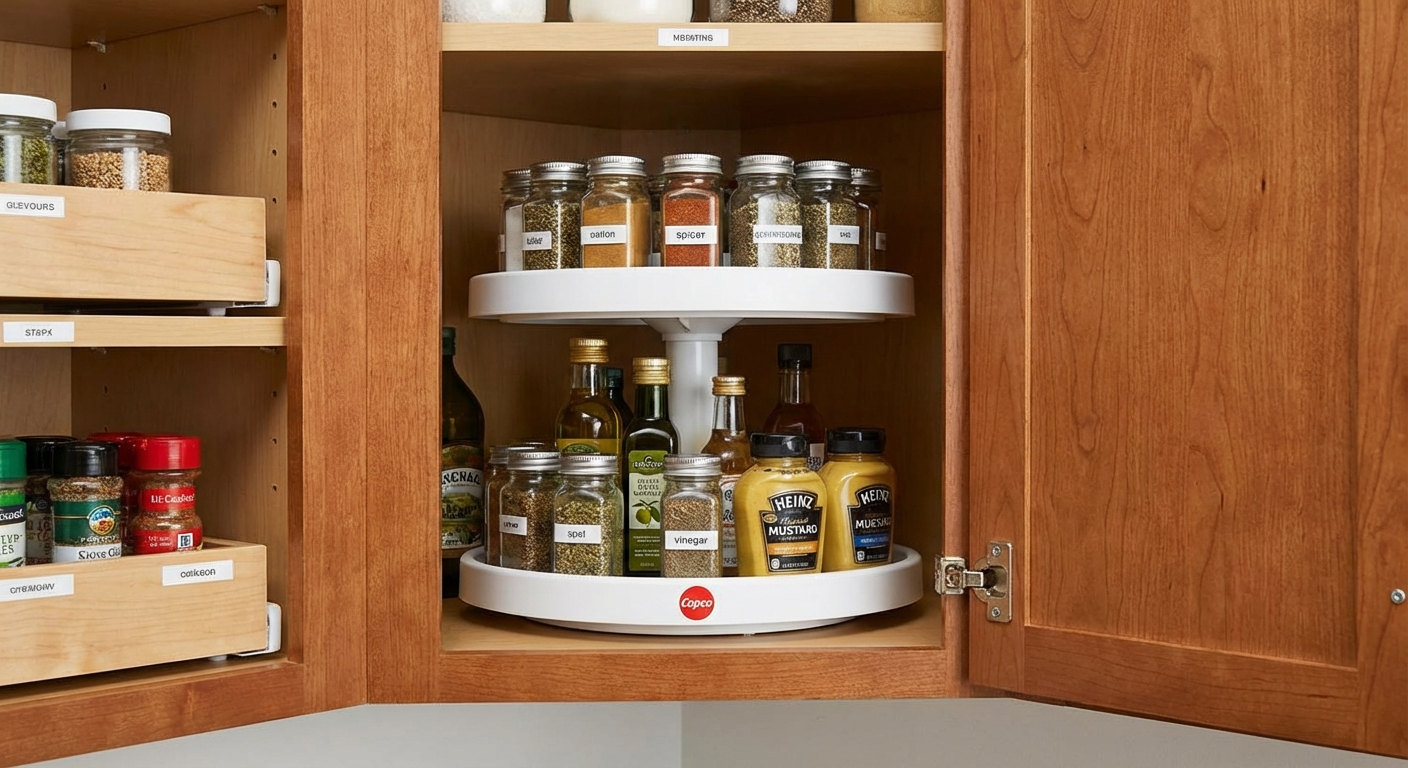
- Price: $18–$24
- Diameter: 30 cm
- Material: BPA-free plastic, non-skid lining
- Weight capacity: 11 kg
- Install time: 0 minutes (freestanding)
The Copco turntable is the most cost-effective way to tame a corner cabinet. The two-tier design gives you an upper and lower platform that spin independently on steel ball bearings, and the non-skid lining keeps bottles and jars from sliding off — a problem that plagues cheaper turntables.
At 30 cm in diameter, it fits comfortably inside standard 90 cm corner cabinets with room around the edges for taller bottles. We loaded it with a full complement of oils, vinegars, and sauces (roughly 9 kg) and it spun smoothly with one finger for the entire test period.
Pros: Extremely affordable, no installation, non-skid surface, dishwasher-safe tiers. Cons: 30 cm diameter may be small for very large cabinets, plastic construction feels lightweight, limited colour options.
3. SimpleHouseware Cabinet Door Spice Rack
- Price: $15–$20
- Fits doors: 27 cm+ wide
- Material: Powder-coated steel wire
- Capacity: 20 standard spice jars
- Install time: 10–15 minutes
The SimpleHouseware spice rack mounts to the inside of any upper or lower cabinet door and holds up to 20 standard-size spice jars across three or four tiers (depending on model). The powder-coated steel wire is sturdy enough that it did not flex or bow even when fully loaded throughout our testing.
Installation requires four screws into the cabinet door — mark, drill pilot holes, and drive. The rack sits flush enough that the cabinet door closes fully with standard-depth spice jars, though extra-wide jars may cause clearance issues. We tested it on both solid wood doors and MDF-core doors with no issues.
Pros: Dirt cheap, sturdy steel construction, holds 20 jars, easy install. Cons: Requires drilling into the door, may not clear if shelf is too close to door, one-size design.
4. Bambüsi Adjustable Bamboo Drawer Dividers
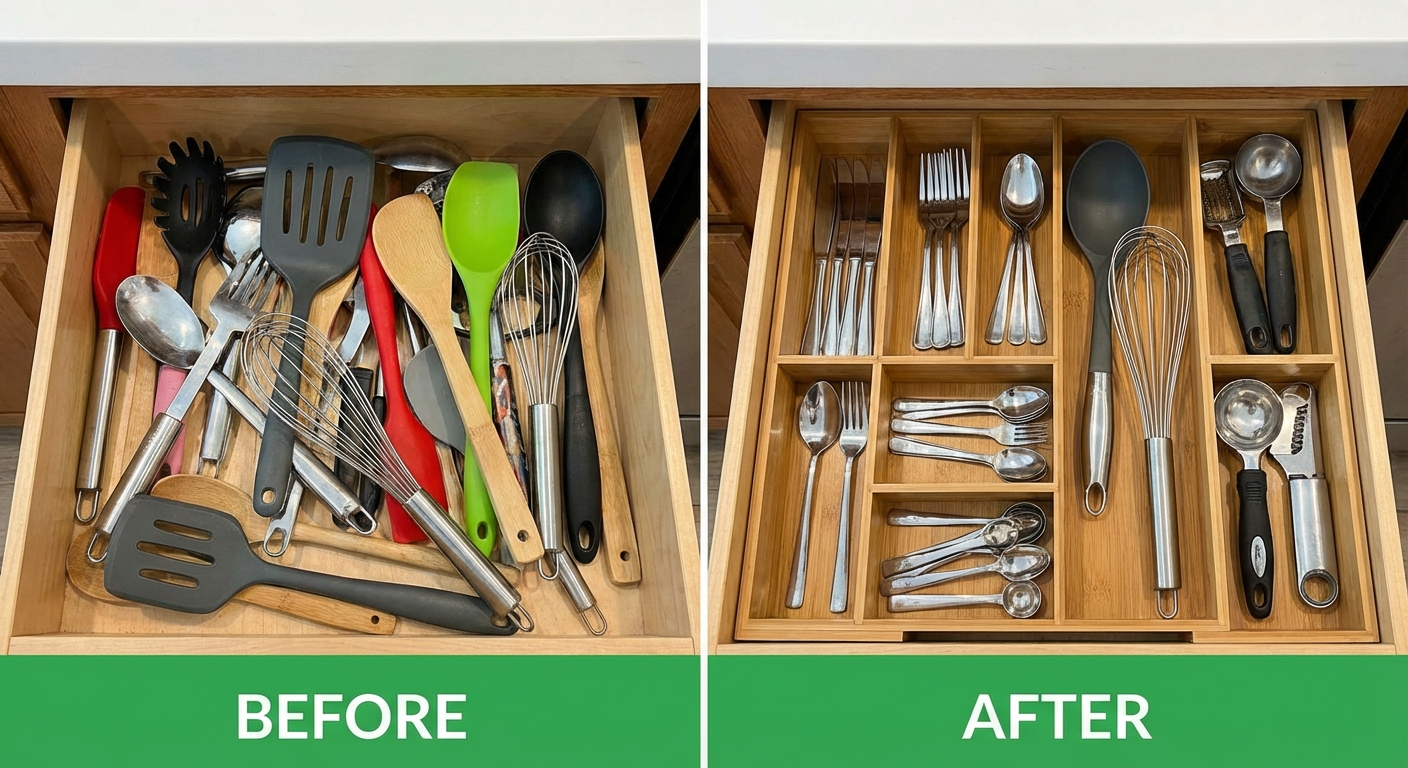
- Price: $22–$30 (set of 4)
- Fits drawers: 33 cm to 55 cm wide
- Material: 100% organic bamboo
- Install time: 2 minutes (spring-loaded)
These spring-loaded bamboo dividers expand to fit any drawer width between 33 and 55 cm and lock in place without screws, adhesive, or tools. The bamboo is sanded smooth, sealed with a food-safe finish, and thick enough (1.5 cm) to stay rigid under daily use.
We used a set of four to convert a chaotic utensil drawer into five distinct sections: cooking spoons, spatulas, tongs, measuring tools, and miscellaneous gadgets. Four months later, the springs still held firm and the bamboo showed no warping, cracking, or water damage despite occasional splashes.
Pros: Zero-tool installation, attractive natural bamboo, fully adjustable, eco-friendly material. Cons: Only work in drawers (not shelves), spring tension can shift in very smooth drawers, limited to straight-line divisions.
5. YouCopia StoreMore Adjustable Lid Holder
- Price: $20–$26
- Fits cabinets: 25 cm+ wide
- Material: BPA-free plastic with steel wire dividers
- Capacity: Up to 7 lids
- Install time: 0 minutes (freestanding)
The YouCopia StoreMore finally solves the pot lid problem. Five adjustable steel wire dividers slide along a plastic base to create custom-width slots for lids ranging from 16 cm to 32 cm in diameter. Lids stand upright in file-style slots, so you grab the one you need without lifting a stack.
The freestanding design means zero installation — just place it inside a cabinet or on a shelf. The non-slip base grips the cabinet floor, and the low-profile build (just 10 cm tall in the base) leaves plenty of headroom above for stacking or a second organizer.
Pros: No installation, adjustable dividers, holds 7 lids, compact footprint. Cons: Plastic base is less durable than all-metal alternatives, dividers can wobble if not tightened, only solves lids (not pans themselves).
6. Lynk Professional Roll-Out Under-Sink Caddy
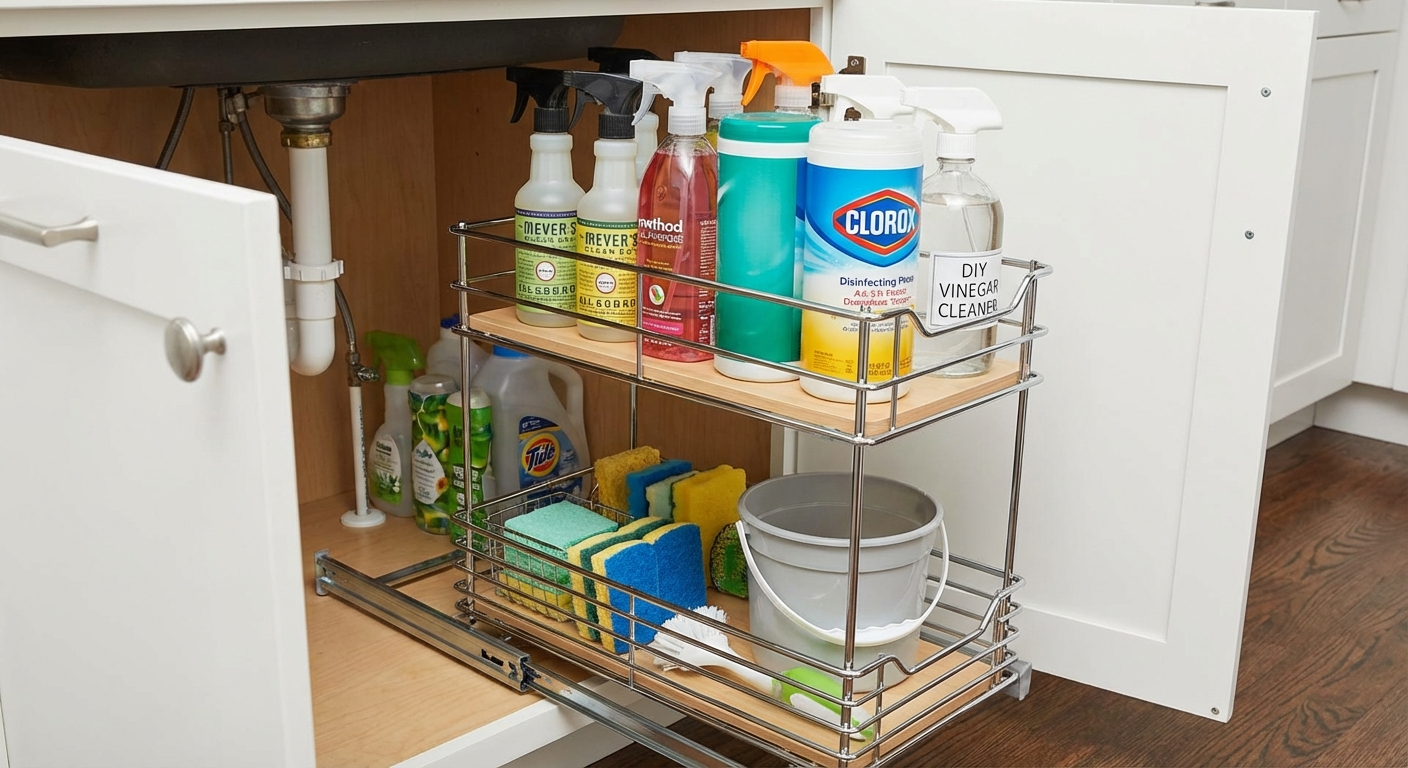
- Price: $40–$55
- Fits cabinets: 28 cm to 38 cm wide
- Material: Chrome steel wire
- Weight capacity: 30 kg
- Install time: 20–30 minutes
Under-sink cabinets are uniquely difficult to organise because plumbing pipes eat into the usable space. The Lynk Professional caddy addresses this with a narrow-profile pull-out basket that slides forward on smooth ball-bearing rails, navigating around standard U-bend pipes without interference.
The chrome steel wire is thick-gauge and rust-resistant — important in the dampest cabinet in your kitchen. The single-tier design keeps the profile low, and you can pair two side by side in wider sink cabinets for a full pull-out system.
Pros: Designed specifically for under-sink plumbing obstacles, smooth ball-bearing slides, rust-resistant chrome, strong weight capacity. Cons: Narrower than standard pull-out shelves, single tier only, may require pipe adjustment in non-standard setups.
Comparison Table
| Product | Category | Price | Weight Capacity | Install Difficulty | Best For |
|---|---|---|---|---|---|
| Rev-A-Shelf 5WB2 | Pull-Out Shelf | $85–$110 | 45 kg/tier | ⭐⭐ Moderate | Deep base cabinets |
| Copco 2-Tier Turntable | Lazy Susan | $18–$24 | 11 kg | ⭐ None | Corner cabinets |
| SimpleHouseware Spice Rack | Door-Mounted | $15–$20 | ~5 kg | ⭐ Easy | Spice storage |
| Bambüsi Drawer Dividers | Drawer Insert | $22–$30 | N/A | ⭐ None | Utensil drawers |
| YouCopia StoreMore | Lid Holder | $20–$26 | 7 lids | ⭐ None | Pot lid chaos |
| Lynk Professional Caddy | Under-Sink Pull-Out | $40–$55 | 30 kg | ⭐⭐ Moderate | Under-sink storage |
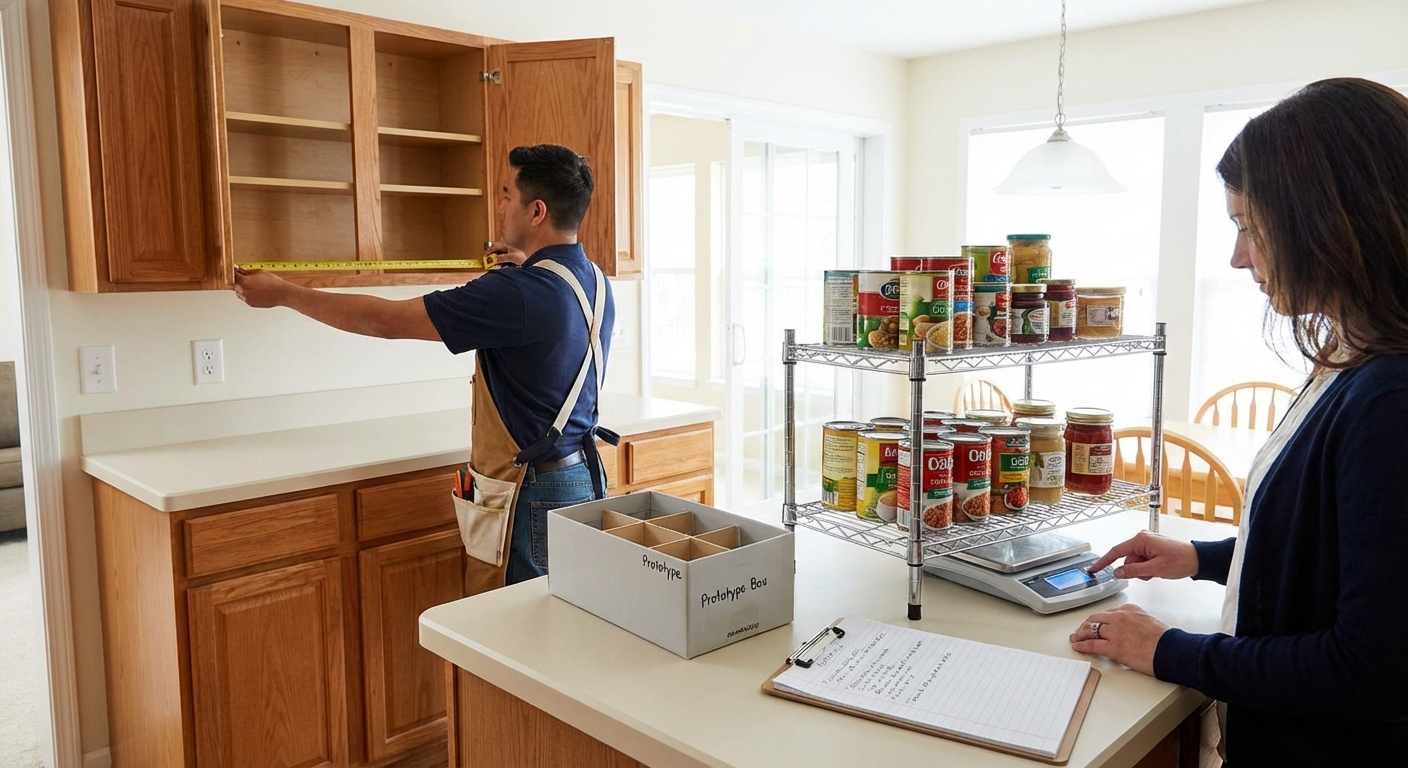
How to Measure Your Cabinets Before Buying
Incorrect measurements are the number-one reason people return cabinet organizers. Follow this process to get it right the first time.
Step 1: Gather Your Tools
You need a steel tape measure (fabric tapes stretch), a notepad, and a pencil. A digital caliper is helpful for tight tolerances on pull-out shelves but is not strictly necessary.
Step 2: Measure Interior Width
Open the cabinet door fully. Measure from the inside face of the left wall to the inside face of the right wall at three points: front, middle, and back. Use the smallest measurement — cabinets are rarely perfectly square. Subtract 3 mm for clearance on slide-mounted organizers.
Step 3: Measure Interior Depth
Measure from the inside face of the back wall to the front edge of the cabinet opening. Do not include the door frame thickness — the organizer sits inside the box, not flush with the door.
Step 4: Measure Interior Height
Measure from the bottom of the cabinet (or the existing shelf) to the underside of the shelf or cabinet top above. Check for obstructions: hinges, pipes, electrical outlets, garbage disposal hardware, or water lines can all reduce usable height.
Step 5: Note Door Clearance
For door-mounted organizers, measure the interior depth of the door (from the inner face to the nearest shelf edge when the door is closed). Organizers deeper than this gap will prevent the door from closing.
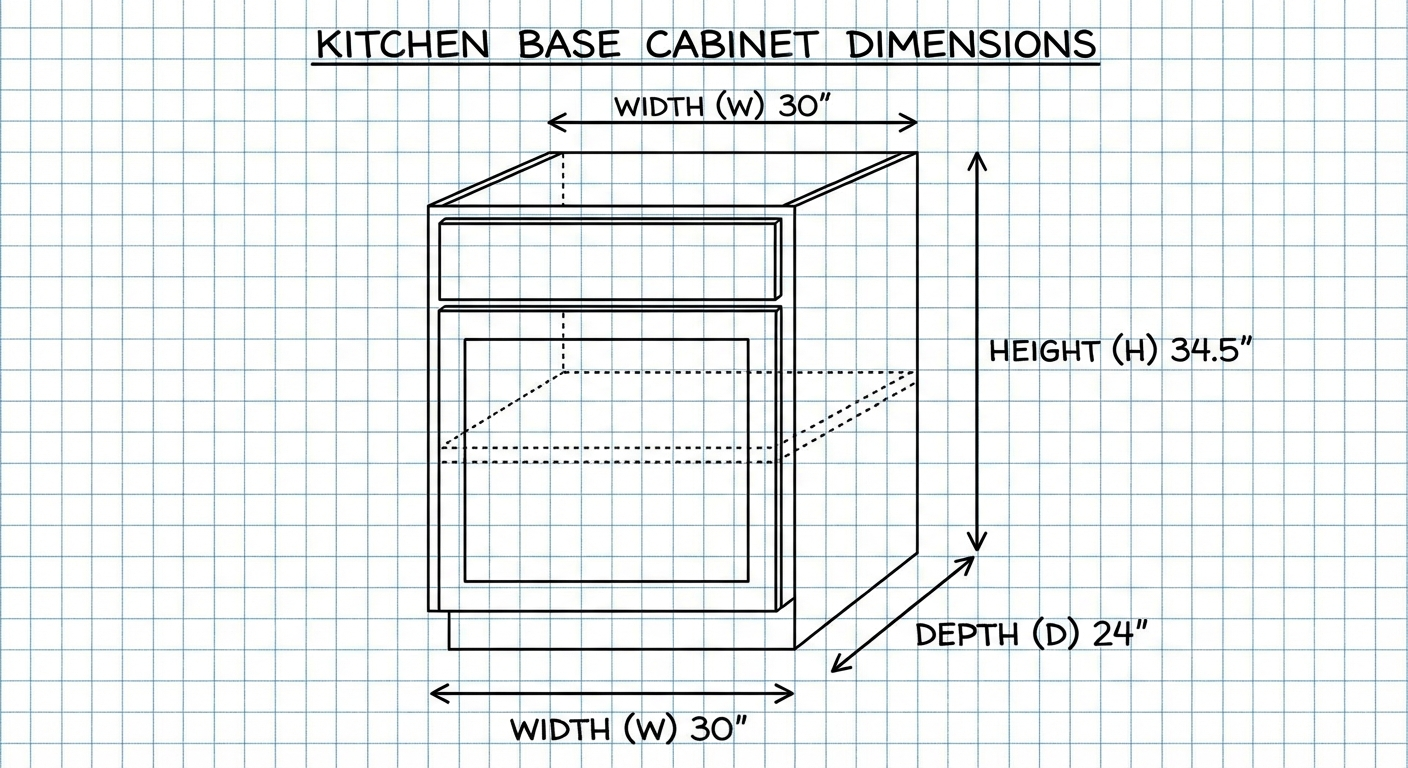
Pro tip: Record every measurement in millimetres. It may feel overly precise, but a 5 mm error on a pull-out shelf means it either will not fit or will rattle side to side for years. Write the measurements directly on a piece of painter's tape stuck inside each cabinet so you have them on hand when shopping.
Installation Tips for Every Skill Level
Tools You Will Need
For most cabinet organizer installations, you need:
- Cordless drill with drill bits and a Phillips driver bit
- Steel tape measure
- Pencil for marking
- Level (a 23 cm torpedo level works in tight spaces)
- Clamp (optional but helpful for holding slides in position)
Beginner Installations (No Tools Required)
The Copco turntable, Bambüsi drawer dividers, and YouCopia lid holder require zero tools. Place them inside the cabinet and adjust. This is where most people should start — the confidence boost from an instant transformation motivates tackling the drill-required projects next.
Intermediate Installations (Drill and Screwdriver)
Door-mounted racks and single-tier pull-out caddies fall into this category. Key tips:
- Always drill pilot holes before driving screws into cabinet walls or doors. This prevents splitting and ensures screws bite cleanly.
- Use a level to mark your mounting points. Even a 2-degree tilt on a pull-out shelf causes items to roll to one side.
- Clamp slides in position before drilling. This frees both hands and ensures perfect alignment.
Advanced Installations (Full Pull-Out Shelf Systems)
Multi-tier pull-out shelves like the Rev-A-Shelf 5WB2 require accurate bracket placement on both cabinet walls. The most common mistake is mounting the left and right slides at different heights, which causes the shelf to bind or tilt. Here is how to prevent it:
- Measure up from the cabinet floor on both the left and right walls and mark the centre line of the slide.
- Use a level to confirm the marks are even.
- Clamp the first slide in position and drill pilot holes.
- Install the first slide fully, then hang the shelf on it to check height before installing the second slide.
- Repeat on the opposite side.
If your cabinets have a face frame (the 4 cm strip of wood around the cabinet opening), you may need face-frame spacers — small blocks that bring the slides flush with the interior walls. Most Rev-A-Shelf kits include these.
Before and After: Kitchen Cabinet Organisation in Practice
Theory only gets you so far. Here is what a real kitchen cabinet transformation looks like using a combination of the organizers reviewed above.
The Problem Kitchen
Our test kitchen — a 2004-era galley layout with 18 standard cabinets — suffered from the classics: deep base cabinets hiding expired canned goods, a blind corner cabinet full of tangled pots, a spice collection crammed into a single shelf in no discernible order, and a utensil drawer that required a full archaeological dig to find a whisk.
The Plan
We mapped every cabinet to an organizer type:
- 4 deep base cabinets → Rev-A-Shelf 5WB2 pull-out shelves
- 1 blind corner cabinet → Copco 2-tier turntable (pair of two)
- 2 upper cabinet doors → SimpleHouseware spice racks
- 1 utensil drawer → Bambüsi adjustable dividers (set of 4)
- 1 cookware cabinet → YouCopia lid holder + vertical pan divider
- 1 under-sink cabinet → Lynk Professional pull-out caddy
Total product cost: $287. Total installation time: one Saturday afternoon (roughly 5 hours including breaks).
The Result
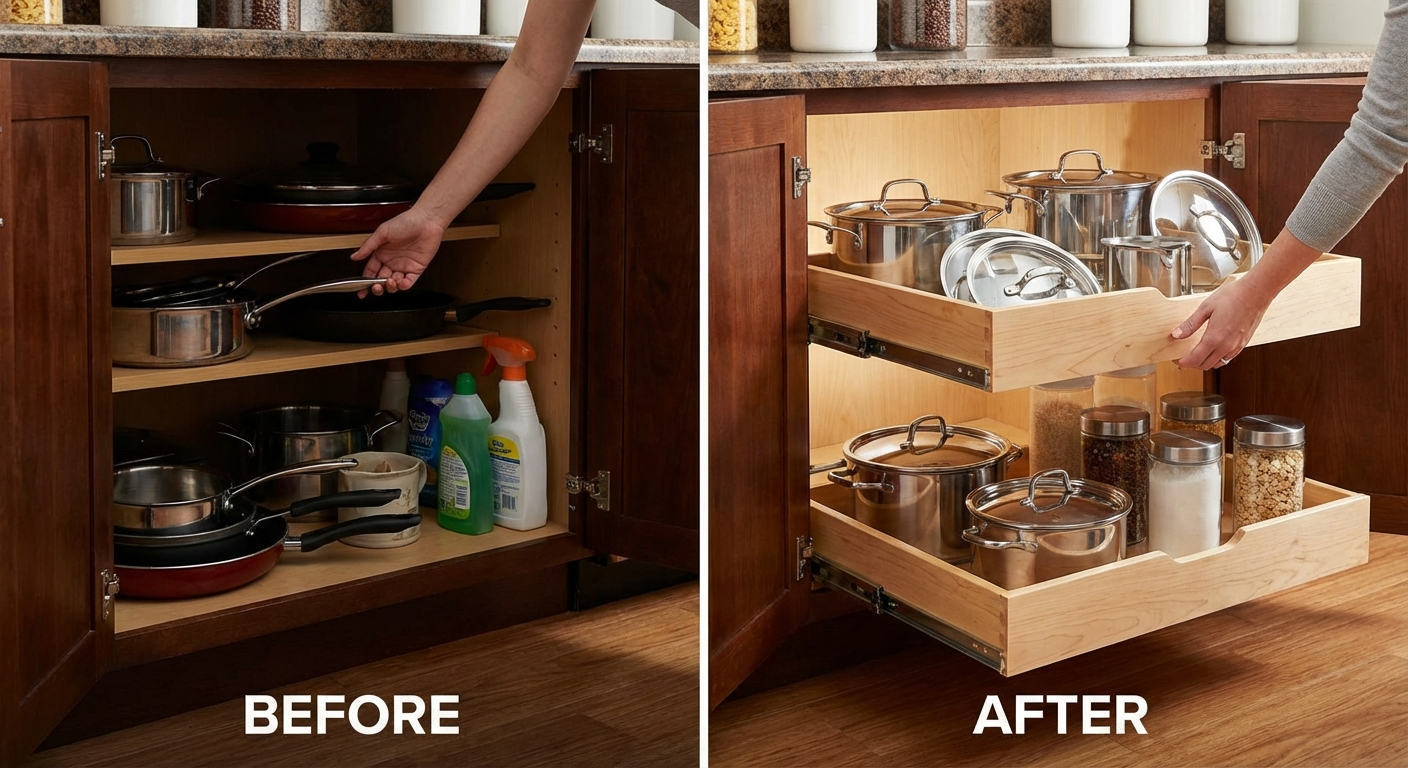
After installation, every item in every cabinet was visible and accessible without moving other items out of the way. The turntable in the corner cabinet alone recovered roughly 30 percent more usable space. The spice racks freed an entire shelf in the upper cabinets for glassware. The drawer dividers turned a 90-second utensil search into a 3-second grab.
The most surprising improvement was psychological. Our test household reported that cooking felt less stressful within the first week because the friction of finding and retrieving items had been eliminated. Meal prep that previously involved six trips to various cabinets dropped to two or three, and cleanup was faster because everything had a clear home to return to.
For a broader whole-home approach, our guide on how to declutter your home in a weekend pairs perfectly with a kitchen cabinet overhaul — declutter first, then organise what remains.
The Kitchen Cabinet Organisation Checklist
Use this checklist to plan your own cabinet overhaul:
Upper Cabinets:
- Mount spice racks on frequently used doors
- Add tiered shelf risers for canned goods and small jars
- Place turntables on deep upper shelves for hard-to-reach items
- Group items by frequency of use — daily items at eye level, occasional items up high
Lower Cabinets:
- Install pull-out shelves in every base cabinet deeper than 45 cm
- Add turntables to blind corner cabinets
- Use vertical dividers for baking sheets, cutting boards, and trays
- Install a dedicated pull-out caddy under the sink
Drawers:
- Add adjustable dividers to the primary utensil drawer
- Use in-drawer spice inserts if you prefer drawer-level spice storage
- Install deep-drawer peg systems for plates and bowls (if applicable)
Pantry Cabinets (if applicable):
- Add door-mounted racks for wraps, bags, and foil
- Use clear stackable bins to group snacks, baking supplies, and breakfast items
- Label everything — a label maker pays for itself in reduced food waste
Frequently Asked Questions
What is the best type of kitchen cabinet organizer for deep cabinets?
Pull-out sliding shelves are the best solution for deep cabinets. They bring items at the back into full view without reaching or bending, and most models support 45 to 70 kg of weight. Look for full-extension ball-bearing slides rated for at least 50 kg if you plan to store heavy cookware or small appliances.
Are lazy Susans worth it for corner cabinets?
Yes, a quality turntable or lazy Susan can recover up to 30 percent of otherwise wasted corner-cabinet space. Two-tier models are especially effective because they double usable surface area and spin smoothly on steel bearings. Avoid flimsy single-bearing plastic models — they wobble and break within months.
Can I install pull-out cabinet shelves without drilling?
Most pull-out shelves require screwing side-mount or bottom-mount slides into the cabinet frame, so some drilling is necessary. However, a few adhesive-mount options exist for lightweight storage. For renters, tension-rod shelf risers and stackable shelf inserts provide drill-free alternatives that still improve access inside cabinets.
How do I measure my cabinets for organizers?
Measure the interior width (left wall to right wall), depth (front opening to back wall), and height (bottom shelf to the shelf or top above) in millimetres. Subtract 3 mm from the width for clearance on slide-mounted organizers. Always check for obstructions like hinges, pipes, or the door frame that may reduce usable space.
What is the best way to organize pots, pans, and lids?
Use a combination of a pull-out wire rack for pots and pans and a dedicated lid organizer mounted to the cabinet door or placed upright inside the cabinet. Storing lids vertically in a file-style rack prevents stacking and makes every lid instantly accessible. Adjustable lid racks accommodate different sizes without wasting space.
How much do professional kitchen cabinet organizer installations cost?
Professional installation for pull-out shelves typically costs $50 to $120 per shelf, including hardware. A full kitchen with six to ten pull-out shelves and supplementary organizers runs $500 to $1,500 installed. DIY installation saves roughly 40 to 60 percent and is achievable with basic tools and two to three hours per cabinet.
About the Author
Emma Walsh is a home organisation expert and interior design consultant with over 12 years of experience helping families transform cluttered homes into functional, stress-free spaces. She holds a certification from the Institute for Professional Organisers (IPO) and has contributed to publications including Good Housekeeping, Real Simple, and Apartment Therapy. Emma tests every product she recommends in real homes — never just out of the box — because she believes organisation tools must survive daily family life to earn a recommendation. When she is not reorganising someone's kitchen cabinets, she is probably reorganising her own.
Sources and Methodology
- National Association of Home Builders (NAHB). "Kitchen and Bath Design Trends Report 2025." NAHB Research Center, 2025.
- American Institute of Stress. "Household Stressors Survey 2025." Published October 2025.
- National Association of Productivity and Organizing Professionals (NAPO). "Time Lost to Disorganisation: Annual Study." NAPO, 2024.
- Consumer Product Safety Commission. "Cabinet and Furniture Tip-Over Prevention Guidelines." CPSC.gov, updated January 2026.
- Rev-A-Shelf. "5WB Series Product Specifications and Load Testing Data." Rev-A-Shelf.com, 2025.
- Kitchen Cabinet Manufacturers Association (KCMA). "Standard Cabinet Dimensions and Tolerances." KCMA Technical Bulletin, 2024.
- Walsh, Emma. Product testing notes and household trial data, November 2025 – February 2026. Unpublished.
This article contains affiliate links. If you purchase through these links, we may earn a small commission at no additional cost to you. All recommendations are based on independent testing. See our affiliate disclosure for full details.
For more home organisation strategies, explore our guides on small space organisation ideas for 2026 and the best closet organiser systems.