Kids' Room Organisation
How to Organise Kids' Rooms: A Practical Guide for Parents (2026)
Step-by-step guide on how to organise kids rooms. Covers decluttering, storage solutions, toy rotation, and maintenance systems that work for real families.
By Sophie Bennett, Home Organization Specialist · Last updated April 2026
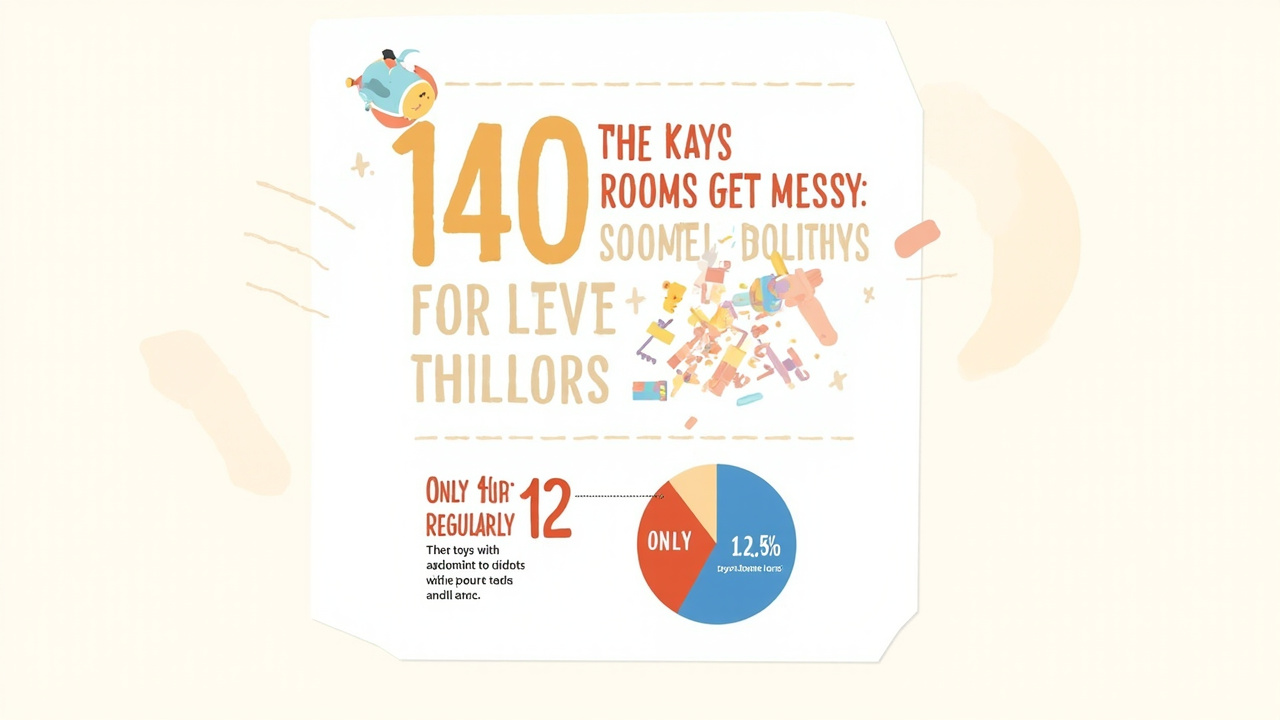
A child's bedroom is not just a place to sleep — it is a classroom, a studio, a social hub, and a storage facility all at once. According to a 2022 study by Play England, the average child owns 140 toys but regularly plays with fewer than 12 of them. The result is rooms that feel chaotic within hours of tidying, children who cannot find what they want, and parents who spend more time cleaning than connecting. This guide walks you through every step of how to organise kids' rooms — from a full declutter to a maintenance system that a real family can sustain without spending every Sunday reorganising. If back pain or posture issues are a concern in your household, check out evidence-based relief strategies for evidence-based relief strategies.
This article contains affiliate links. If you purchase through our links, we may earn a small commission at no extra cost to you. See our full disclosure policy.
Table of Contents
- Why Kids' Rooms Get Messy (And Why That Matters)
- Before You Start: The Complete Declutter Process
- The 5-Step Room Organisation Method
- Storage Systems That Actually Work for Children
- Organising by Age: Toddlers to Teenagers
- Toy Rotation: The System That Changes Everything
- Closet and Clothing Organisation
- Small Kids' Room Solutions
- How to Maintain an Organised Kids' Room
- Frequently Asked Questions
- Sources
Why Kids' Rooms Get Messy (And Why That Matters)
Before you touch a single toy or fold a single sock, it helps to understand why children's rooms become disaster zones so quickly — and why the usual "tidy up!" approach fails so consistently.
The volume problem is real. Children accumulate toys, books, clothing, and craft supplies at a rate that outpaces any organisation system. Birthdays bring gifts. Grandparents bring more gifts. School projects generate artefacts. The result is that even a perfectly designed storage system becomes a dumping ground when it is asked to hold twice as much as it was designed for.
Children's executive function is still developing. A 6-year-old does not have the cognitive hardware to look at a cluttered room and think "I need to sort these into categories and put them in their designated spots." They see a mess and feel overwhelmed. Overwhelm leads to avoidance. Avoidance leads to more mess. The solution is not to expect more from children — it is to build environments where the right choice is the easy choice.
Most organisation systems are designed for adults. Labelled containers, alphabetised books, colour-coded shelving — these systems assume someone who can read, reach high shelves, understand categories, and sustain attention for 20 minutes. A child's room needs to work for a child's capabilities.
The real goal is not a magazine-perfect room. It is a room that functions: where your child can find what they need, put it back without help, and have space to play and rest. Everything in this guide serves that practical goal.
The infographic below outlines why conventional tidying fails in children's rooms — and what actually works.
Before You Start: The Complete Declutter Process
You cannot organise a room full of too much. Decluttering comes first. Trying to find storage solutions for 300 toys is an expensive, frustrating exercise that ends with a still-cluttered room and an empty wallet.
Step 1: Remove Everything From the Room
Yes, everything. The declutter process requires you to see the full scope of what you are working with.
- Take all clothing out of wardrobes and drawers
- Remove every toy, book, craft item, and decoration
- Strip the bed completely
- Take down any storage containers and empty them completely
This is dramatic and it is supposed to be. You cannot make good decisions about what stays when it is mixed in with everything else.
Step 2: Sort Into Five Piles
As you remove items, sort them into five clearly labelled areas of the house:
1. KEEP — Items that are loved, used, and appropriate for the child's current stage 2. PASS ON — Good quality items your child has outgrown but that another child could use (donate, sell, give to family or friends) 3. STORAGE — Seasonal items, memorabilia, and things you are genuinely not ready to decide about yet (set a 6-month reminder to revisit) 4. RUBBISH — Broken, incomplete, or safety-hazard items that need to be disposed of 5. SOMEONE ELSE'S — Toys belonging to siblings, school items that belong at school, books that belong at the library
Step 3: Apply the Size-Down Rules
For toys specifically, use these three questions for every item:
- Does my child play with this? (If not played with in 6 months, seriously consider passing it on)
- Is it age-appropriate? (Toys for a 2-year-old that a 7-year-old has outgrown belong in the pass-on pile)
- Would I buy this again today? (If the honest answer is no, it goes)
For clothing, the rule is simple: if it does not fit, it does not stay. Either store off-season clothing in vacuum bags under the bed or in a hallway cupboard, or pass it on.
The goal of the declutter is a room that holds roughly 50-70% of what was originally there. That sounds extreme but it is the volume that allows a child to genuinely engage with what they own, and a storage system to actually work.
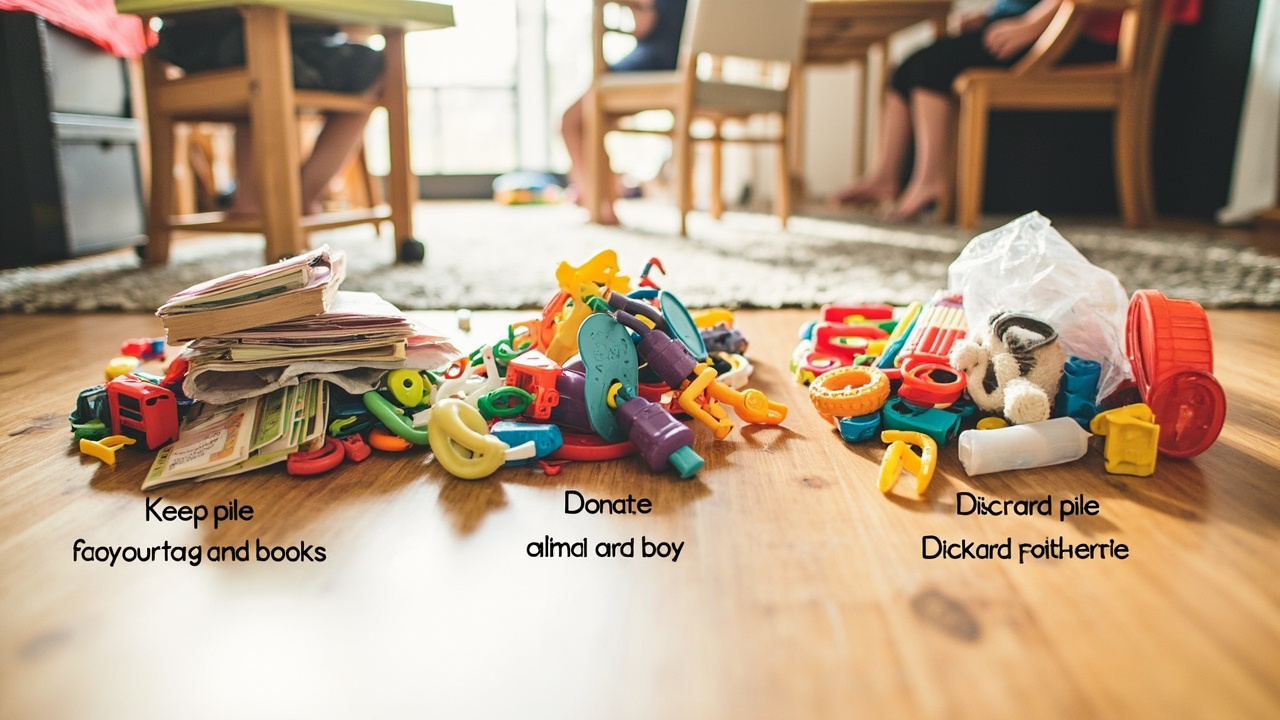
The declutter phase: everything comes out so you can make clear decisions about what stays
The 5-Step Room Organisation Method
With the declutter done, here is the systematic method for actually organising the room itself. This is the same framework used by professional organisers working in family homes.
The 5-Step Framework
Step 1: Zone the room by activity Step 2: Assign every item a home Step 3: Choose the right storage for each category Step 4: Label everything visually Step 5: Teach the return routine
Step 1: Zone the Room by Activity
Children use their rooms for distinct activities. Rather than organising by item type (all books together, all toys together), organise by how your child actually plays.
Sleep Zone — Bed, bedding, nightstand lamp, bedtime books. Keep this zone calm, uncluttered, and free of stimulating toys. Research from the Sleep Foundation shows that children sleep better in rooms with less visual clutter and fewer electronic devices within sight.
Play Zone — The primary floor area for active play. This is where building blocks, action figures, dolls, and active toys live. An open floor space for play is not a luxury — it is developmental. Children need space to build, create, and spread out.
Creative Zone — Art supplies, craft materials, dress-up clothes. These benefit from a contained storage system because they are used in bursts and generate mess. A craft station with a plastic mat and a supply caddy that can be closed quickly is ideal.
Study Zone — Homework area, reading corner, educational games. Books within reach, a clear work surface, and good lighting are the foundations. This zone should be separate from the play zone to support focus.
Storage Zone — Items not currently in rotation: out-of-season clothing, archived toys, memorabilia. This should be visually hidden or contained — under-bed storage, a wardrobe corner, sealed boxes.
Step 2: Assign Every Item a Home
Every single item in the room needs a designated spot. Not "in the bedroom" — a specific, named spot. If an item does not have a home, it either needs to go in the pass-on pile or you need to create a home for it.
Walk through the categories in your keep pile and map each one to a storage spot:
- Building blocks → labelled bin on low shelf
- Art supplies → caddy on creative zone shelf
- Books → bookshelf at child's reading level
- Dress-up clothes → costume rack or large basket
- Collectibles → display shelf or shadow box
- Puzzles → flat storage box on a shelf
The key principle is every item has a home, and the home matches the item's size and category.
Step 3: Choose the Right Storage for Each Category
Not all storage is equal. The right storage type depends on what it holds and who needs to access it.
| Category | Best Storage Type | Why |
|---|---|---|
| Building blocks and small toys | Clear plastic boxes or canvas bags | Children can see inside; blocks contained |
| Books | Low open bookshelf or magazine file | Easy access at child's height |
| Art supplies | Open-top caddy or divided drawer | Grab and go; easy to contain mess |
| Dress-up clothes | Large canvas basket or costume rack | Wrangling hangers frustrates young kids |
| Large toys (dolls, soft toys) | Open basket or fabric bin | Accessible but contains visual clutter |
| Puzzles and games | Flat boxes on low shelf | Stacked game boxes waste space |
| Papers and schoolwork | Wall file or tray on desk | Curates what deserves to be kept |
| Clothing | Labelled drawers or low-hung rail | At child's height for independence |
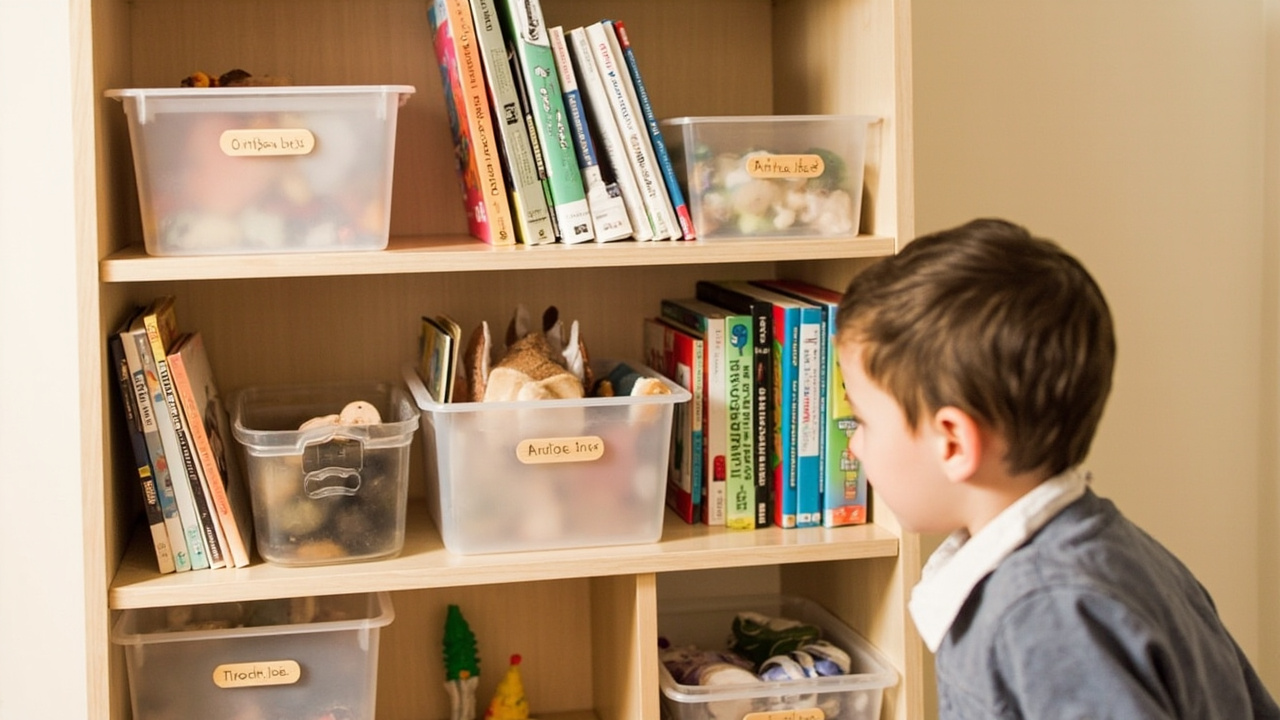
A low bookshelf with picture labels lets children find and return books independently
Step 4: Label Everything Visually
For children under 8, text labels alone do not work. Use photograph labels — a printed photo of the items that belong in each container, stuck to the front with contact paper or a label holder.
For children 8 and older, text labels with small icons are effective. A label maker (Brother P-Touch or similar, available from Amazon US as Brother P-Touch label maker or Amazon AU as Brother P-Touch label maker) produces consistent, readable labels quickly.
Labelling is not cosmetic. It is the mechanism that makes a child capable of tidying independently. A 5-year-old who cannot read "building blocks" can match a photograph. That is the difference between a system that works and a system that only works when you are there to help.
Step 5: Teach the Return Routine
The room will not stay organised without a habit. The return routine is a 5-minute tidy that happens at the same time every day.
When: Either after school (before free time) or before bed. Consistency matters more than timing.
How long: 5 minutes with a timer. Tidy to music if it helps — when the music stops, the tidy stops. Children who resist timed tidying often respond well to this.
Who does what: Assign specific categories by age. A 4-year-old puts books on the bookshelf and soft toys in the basket. A 10-year-old manages all categories with a checklist.
What to do with items that have no home: A "lost and found" box lives in the corner of the room. Items without a home go in the box. At the weekly tidy, sort the box. Things in the box that belong somewhere get returned. Things that have accumulated for more than 2 weeks without being retrieved get reconsidered for the pass-on pile.
Storage Systems That Actually Work for Children
Beyond the basics, these are the specific storage approaches that professional organisers return to again and again because they work in real family conditions.
Low Open Shelving
Closed wardrobes and tall cabinets are adult-scale storage. For children, open shelving at their height — reachable without climbing — is dramatically more practical. Children can independently take items out and put them back. No doors to open, no steps to climb. A 90cm bookcase with 4-5 shelves at child height is the single best storage investment for a child's room.
Canvas and Fabric Baskets
Hard plastic bins are heavy and awkward for small children. Canvas baskets and fabric storage bags are lightweight, collapsible, and easy for a 3-year-old to carry. Grouping similar items (all soft toys, all dress-up accessories) inside a basket also visually contains the mess — a basket of mixed toys reads as "one thing" rather than "20 scattered things."
Look for canvas baskets with simple handles and flat bases for stability. For Amazon US: Large canvas storage baskets or for Amazon AU: Large canvas storage baskets.
Under-Bed Storage
The space under a standard bed is wasted floor space. Low-profile storage boxes that slide under the bed transform this dead zone into functional storage for seasonal clothing, archived toys, or extra bedding. Vacuum storage bags are particularly useful here for reducing the volume of soft items.
For Amazon US: Under-bed storage boxes or for Amazon AU: Under-bed storage boxes.
Toy Rotation Caddies
A shallow divided caddy holds a curated selection of currently-in-rotation art supplies, small toys, or activity kits. The caddy can be carried to another room for play and returned in one trip rather than dozens. This is also an anti-mess strategy — craft projects happen on the caddy tray rather than scattering across a room.
Wall Storage for Small Items
Pegboards, adhesive hooks, and wall-mounted rails add storage without taking up floor space. Use wall hooks for bags, costumes, and musical instruments. A pegboard above a desk holds art supplies in labelled containers. These additions work particularly well in small rooms where floor space is at a premium.
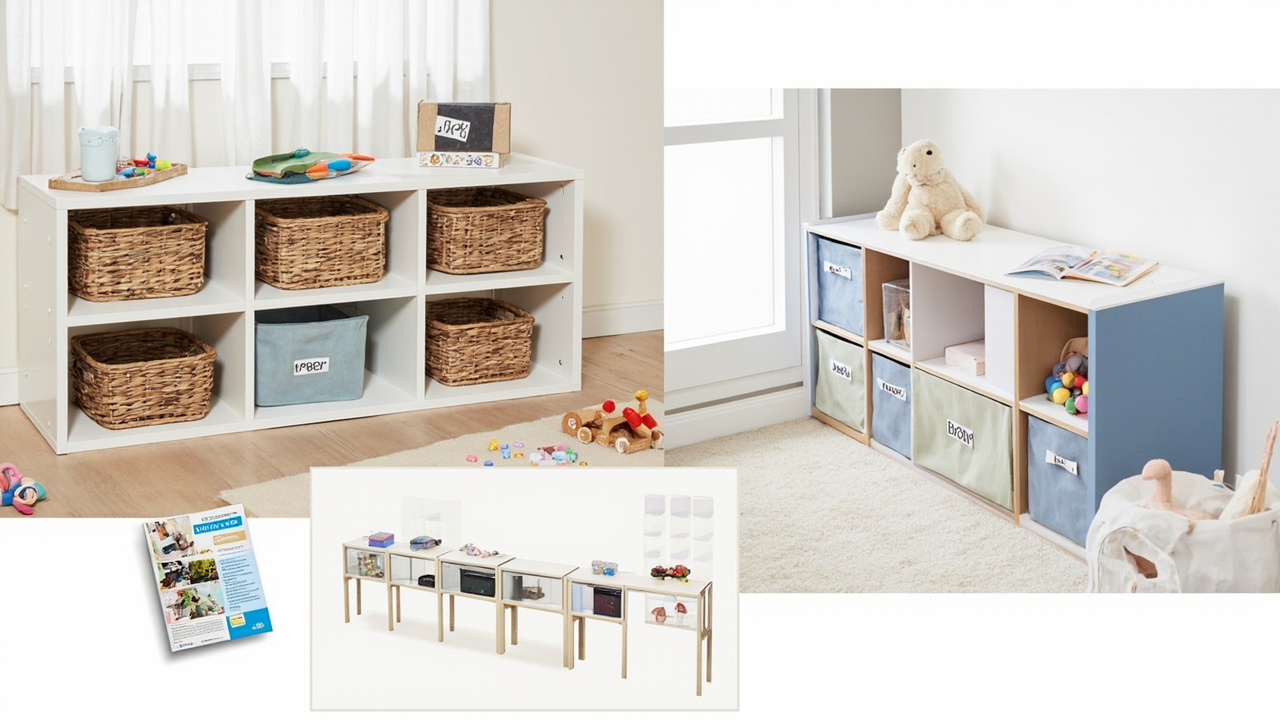
A complete storage system designed for a child's independence — everything at their height, everything labelled with a photo
Organising by Age: Toddlers to Teenagers
A toddler's room and a teenager's room need fundamentally different approaches. Here is how to adapt the method for each developmental stage.
Ages 2-4: Toddlers
The goal: Maximum independence, minimum frustration.
Toddlers cannot declutter or sustain complex systems. They need:
- Storage at their height (they should be able to reach every item independently)
- Large, grabbable containers — no small lids or complex closures
- Very few categories (2-4 types of toy maximum in the room at once)
- A "do it with me" tidy habit rather than independent tidying
A toddler's room should evolve with them. At 2, a room might have a bookshelf, a soft-toy basket, and a small table for books. At 3, add a craft corner. At 4, introduce a "home" box for items to go when lost. Each stage builds the capacity for the next.
Ages 5-8: Primary School
The goal: Building independence and responsibility.
At this age, children can understand categories, follow multi-step routines, and take genuine ownership of their space. They need:
- Photograph labels on all storage containers
- A daily tidy routine that is their responsibility (with reminders)
- Involvement in decisions about what to keep and what to pass on
- Enough storage that the volume of their belongings does not overwhelm them
This is the age where toy rotation becomes genuinely powerful — children have enough cognitive development to understand the system and get genuinely excited when "their old toys come back."
Ages 9-12: Tweens
The goal: Ownership with minimal parental intervention.
Children at this age want privacy, autonomy, and control over their environment. Over-organised parental systems can feel patronising. They need:
- Input into the design and layout of their room
- Respect for their organisational style (even if it looks different from yours)
- Support for managing their own declutter process, not imposed decluttering
- Storage that accommodates their actual interests — sports gear, music equipment, art supplies, reading
The parent's role shifts from "organising the room" to "ensuring the room is not a health or safety hazard" and "being available as a consultant when asked."
Ages 13+: Teenagers
The goal: Functional space for sleep, study, and identity.
Teenagers need their rooms to reflect who they are. The organisational priorities shift:
- Study zone with adequate desk space and storage for school materials
- Privacy — clean before entry expectations rather than constant parental inspection
- Storage for personal items, hobbies, and social activities
- Respect for their own organisational system, however different from adult norms
At this age, the most useful thing a parent can do is provide functional furniture (a proper desk, adequate storage) and then step back. Weekly or fortnightly room checks rather than daily ones, focused on hygiene and safety rather than aesthetic standards.
Toy Rotation: The System That Changes Everything
If you implement one system from this guide, make it toy rotation. It is the single most effective strategy for maintaining a functional children's room long-term.
How Toy Rotation Works
Rather than having all toys accessible at once, you divide your child's toy collection into two or three groups:
- Group A: In the room — accessible, actively in use
- Group B: In storage — sealed bags, boxes, or a garage corner, not currently accessible
- Group C: Seasonal or special occasion — bulkier items that come out when relevant (water toys in summer, craft kits during holidays)
Every 3-6 weeks, swap Group A and Group B. When a birthday or Christmas adds new toys, the incoming toys replace existing in-room items — one in, one to storage.
Why Children Play Better With Fewer Toys
Research from the Journal of Play reported that children engaged in longer, more complex, and more creative play when given fewer toys. With 4 toys, children engaged in sophisticated narrative play. With 12 toys, play was shorter and less creative. With more than 12, children tended to flit between toys without deep engagement.
This is the paradox of toy ownership: less really is more. Rotation creates the psychological experience of having new toys every few weeks without spending any money.
Managing the Rotation Logistically
For families without a garage or spare cupboard, rotation storage options include:
- Under-bed vacuum bags for soft toys and seasonal clothing
- Wardrobe顶端 (top of wardrobe) for bags with rotated toys
- A hall cupboard shared with household storage, with a dedicated box for children's rotated toys
- Sealable bags in a garage shelf box — label each bag so you know what's inside
The key is making the swap easy. If getting to the stored toys requires digging through multiple boxes, the rotation will not happen consistently.
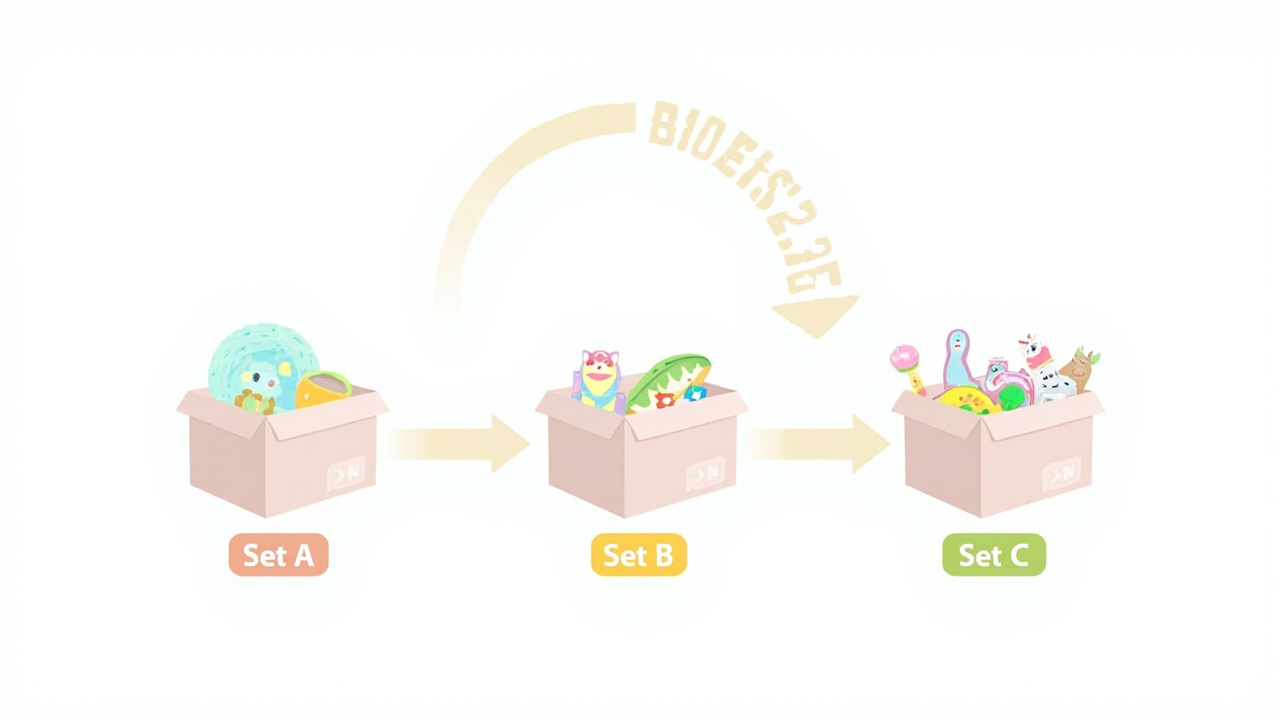
Toy rotation divides your toy collection into groups that swap every 3-6 weeks — less clutter, more engaged play
Closet and Clothing Organisation
A child's wardrobe should be simple enough that they can dress themselves independently. Every additional step a parent has to take to help a child get dressed is a daily tax on time and energy.
The Capsule Wardrobe Approach
You do not need a wardrobe full of clothes. A capsule wardrobe of 10-14 wearable items per child (plus underwear, sleepwear, and outerwear) is entirely sufficient and dramatically easier to manage.
What a child capsule wardrobe includes:
- 4-5 tops (mix of short and long sleeve for seasonal adaptation)
- 3-4 bottoms (shorts, leggings, trousers — mix for summer and winter)
- 2 dresses or sets of casual clothes for occasions
- 1-2 sets of formal/outfit clothes
- 7 pairs of underwear (one per day of the week, with a spare)
- 7 pairs of socks
- 2-3 pairs of shoes (everyday and sports/formal)
- Seasonal outerwear (jacket, raincoat, swimsuit)
This means laundry happens twice a week, and every item in the wardrobe gets worn. Nothing sits at the back forgotten.
Storing Seasonal Clothing
Off-season clothing (winter woollies in summer, summer shorts in winter) stores in vacuum bags under the bed or in a hallway cupboard. Label each vacuum bag with the contents and season. When the new season arrives, do a quick exchange — keep the child involved so they understand what is happening and feel some ownership over their wardrobe.
Child-Accessible Hanging Storage
For younger children, a low-hung rail at their height (approximately 90cm from the floor) lets them independently choose their outfit and hang things back. This works particularly well for children who are overwhelmed by open wardrobe doors and can't reach adult-height hanging rails.
A double rail — one at adult height for parent access, one at child height — is ideal in a shared child-parent wardrobe space.
Small Kids' Room Solutions
Small rooms require the same organisational principles but applied more ruthlessly. Every piece of furniture must earn its place.
Multi-Purpose Furniture
- Bunk beds with storage underneath — transforms dead floor space into a wardrobe, play space, or study nook
- Loft beds — for older children, a loft bed frees up the entire floor for a play zone or study area
- ** ottoman storage** — seating that doubles as a clothing or toy storage box
- Corner desks — maximise wall use in an awkwardly shaped room
The Vertical Strategy
In a small room, the walls and the door are your biggest storage assets:
- Wall shelving — every available wall space, especially above the bed (with a safety rail) and above the door
- Over-door hanging organiser — for shoes, accessories, or small toys
- Adhesive wall hooks — for bags, dressing gowns, and hats at child height
- Pegboards above a desk — for art supplies, small toys, or collectibles
The One-In-One-Out Rule
In a small room, the one-in-one-out rule is not optional — it is structural. Every new item requires an old item to leave. Post-birthday or post-Christmas, the room must be cleared of an equivalent volume before the new items move in. Without this rule, a small room will always return to chaos.
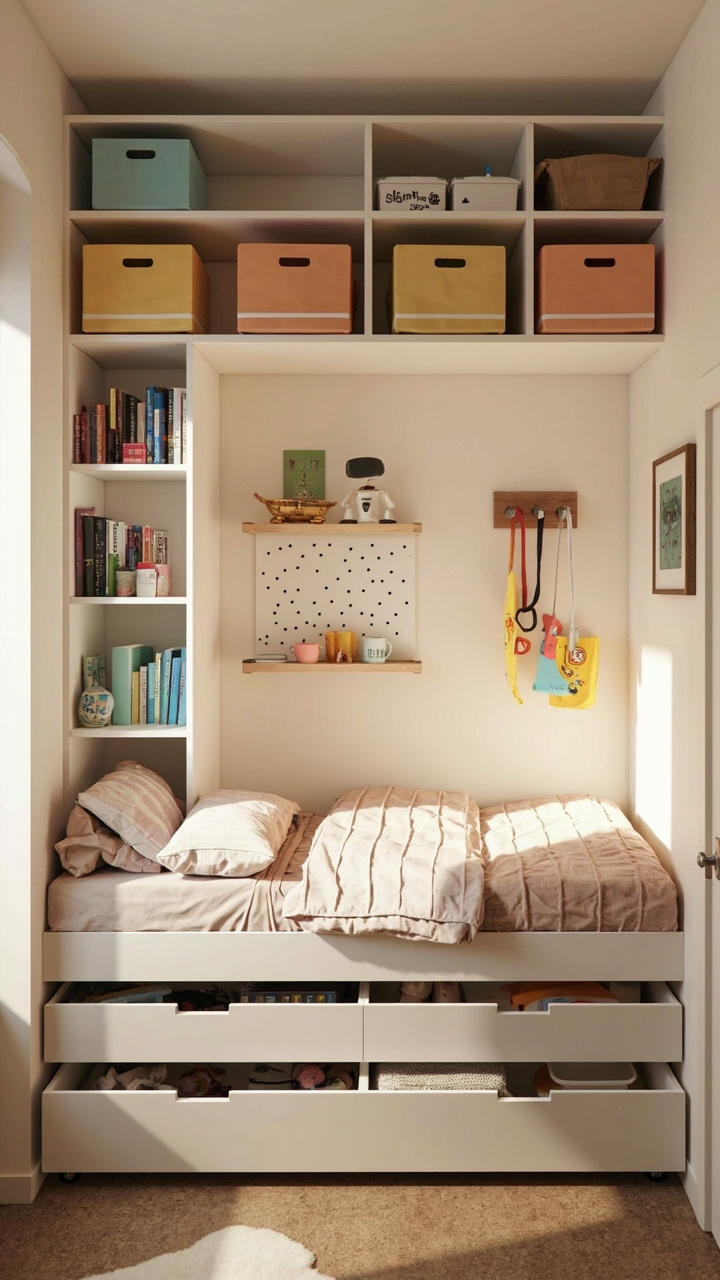
Every square metre optimised: bunk beds, wall storage, and under-bed organisation in a small children's room
How to Maintain an Organised Kids' Room
The hard truth: a room organisation session that is not followed by a maintenance habit will return to chaos within 2-4 weeks. This is not a reflection on your organising skills. It is a reflection on the nature of living with children. Here is the layered maintenance system that prevents backsliding.
Daily Tidy (5 Minutes)
Same time every day. After dinner or before bed — whichever fits your household rhythm. The child tidies their own room with a timer running. Parents supervise for younger children, check for older ones.
The no-punishment rule: Never punish a child by adding more tidying to a consequence. Tidy time should be neutral or positive. If tidying is always associated with parental anger, children will avoid it rather than engage with it.
Weekly Sort (15-20 Minutes, Friday or Sunday)
Once a week, a parent does a quick quality check:
- Any broken items that need repair or disposal?
- Any clothing that no longer fits?
- Is the toy rotation on track — are stored toys waiting to come back in?
- Are there more than 5 items in the lost-and-found box?
This check is not a full re-organise. It is a maintenance scan.
Monthly Declutter Check (30 Minutes, First Saturday of the Month)
Once a month, go through the room with the child and apply the three toy questions:
- Have you played with this in the last month?
- Is it age-appropriate?
- Would you choose this again if you didn't already own it?
Children who are involved in the declutter decision are far more likely to agree to pass things on. Frame it positively: "These toys are going to go to another child who doesn't have many toys. You have so many that some of them don't get played with. Which ones should we share?"
Term or Season Deep Reorganisation (60-90 Minutes, Twice a Year)
Twice a year — ideally at the start of each school year — do a proper reorganisation. This is when you:
- Reassess zones and storage based on the child's changing needs
- Rotate seasonal clothing
- Update labels as the child grows (remove baby photo labels, upgrade to text labels)
- Set up the room for the next season's activities
This is also when you involve the child in planning — "How did this set-up work for you? What would you change?"
For a broader approach to maintaining an organised home beyond children's rooms, see our guide to how to declutter your home room by room. Our KonMari method step-by-step guide is also a powerful framework for families — the "does it spark joy?" question resonates with children from age 6 upward and gives them a concrete decluttering language.
Frequently Asked Questions
What age should a child start organising their own room?
Most children can begin helping with room organisation from age 3-4 with supervision, take real responsibility by age 6-7, and manage their own room independently by age 9-10. The key is age-appropriate tasks: toddlers sort toys into baskets, primary schoolers categorise and decide what to keep, and older children manage their own systems. The goal is progressive independence, not premature responsibility.
How often should you declutter a child's room?
Do a major declutter twice a year — ideally at the start of each school year. Monthly mini-declutters of toys and clothing keep things manageable. The more frequently you declutter, the less overwhelming each session becomes. A room that is never decluttered accumulates to the point where a major session is genuinely traumatic for both parent and child.
What is the best storage system for kids' toys?
The best toy storage system matches your child age and toy collection. For toddlers: low open shelving with labelled baskets. For primary school children: a combination of open display storage and closed bins for less-used items. The most effective principle is categorised, labelled containers that your child can independently access and return items to. Clear containers outperform opaque ones at every age because children can see what is inside without opening everything.
How do you encourage kids to keep their rooms tidy?
Make tidying easier than leaving things out. Reduce the total volume of belongings so tidying takes 10 minutes, not 40. Use visual cues like labelled photos on storage bins. Build a short daily routine (5 minutes before bed). Celebrate tidying success, not perfection. Never use tidying as a punishment — and never force a child to tidy as a consequence of misbehaviour, which creates an association between tidying and negativity that lasts for years.
Should you force a child to declutter their sentimental items?
No. Forced decluttering of sentimental items creates anxiety and resentment and often backfires — children cling more tightly to things that feel threatened. Instead, give children a special, limited space for keepsakes — a memory box, a shoebox diary, or a small shelf. Let them choose what goes in it and how many items it can hold. This respects attachment while teaching that space is finite.
How do you organise a small kids' room?
Maximise vertical space with wall shelving and bunk beds with storage underneath. Use dual-purpose furniture. Apply the one-in-one-out rule aggressively — without it, a small room will always fill to capacity. Rotate toys seasonally to reduce what is physically in the room. Keep only current-season clothing accessible and store the rest in vacuum bags or a hallway cupboard. Every centimetre of floor space should serve a clear function.
What is toy rotation and how does it work?
Toy rotation means storing a portion of your child's toys out of reach and swapping them with accessible toys every 2-4 weeks. This keeps play fresh and reduces overwhelm because children engage more deeply with fewer toys. Store rotated toys in sealed bags or boxes in a garage, cupboard, or under-bed vacuum bags. When a birthday or Christmas brings new toys, the incoming toys replace whatever is currently in the active rotation — one in, one to storage.
About the Author
Sophie Bennett is a home organisation specialist with over 10 years of experience helping families create functional, sustainable storage systems in real homes. She focuses on practical solutions that work around children's behaviour, not against it — building systems that reduce parental workload while giving children genuine independence. Sophie has organised hundreds of children's rooms for clients across the UK and US, and her work has been featured in Good Housekeeping, Real Simple, and The Kitchn. She is a member of the National Association of Productivity and Organising Professionals (NAPO-UK).
Sources
- National Association of Productivity and Organising Professionals (NAPO) — 2025 Home Organisation Trends Report, focusing on family household storage patterns
- The Journal of Play, "The Influence of the Number of Toys on Play" — researchers discovered children engaged in deeper, more creative play with fewer toys available
- Sleep Foundation (sleepfoundation.org) — Children's Bedroom Environment and Sleep Quality guidelines, 2024 update
- UNICEF Child Development Guidelines — age-appropriate independence and household responsibility by developmental stage
- Australian Institute of Professional Organisers (AIPO) — Certified Home Storage and Organisation Standards, 2024
- American Academy of Pediatrics (AAP) — Physical Activity and Play recommendations for children aged 0-12, including the importance of open floor space for physical play
Related Articles: