Decluttering
How to Declutter Your Home in a Weekend (Step-by-Step Plan 2026)
Declutter your entire home in one weekend with our expert step-by-step plan. Room-by-room guide, the 4-box method, and pro tips to stay clutter-free long-term.

You can declutter your entire home in a single weekend. The secret is not motivation — it is a structured, room-by-room battle plan that breaks the project into manageable time blocks. This guide gives you the exact Saturday-to-Sunday schedule, the proven 4-box sorting method, and the maintenance habits that keep clutter from creeping back.
By Jamie Chen, Professional Organizer and KonMari Consultant · March 20, 2026
Table of Contents
- Before You Start: Weekend Declutter Preparation
- The 2-Day Battle Plan
- The 4-Box Method Explained
- Room-by-Room Decluttering Guide
- Best Decluttering and Storage Products
- 30-Second Video Summary
- Your Wardrobe: A Detailed Deep-Dive
- Staying Clutter-Free Long-Term
- Frequently Asked Questions
- Conclusion
- Sources and Methodology
Before You Start: Weekend Declutter Preparation
The single biggest reason weekend declutter attempts fail is lack of preparation. You do not want to waste Saturday morning hunting for bin bags or driving to buy storage containers. Everything should be ready by Friday evening.
Supplies Checklist
Gather the following before you begin:
- Four large boxes or bags — one each for Keep, Donate, Trash, and Relocate
- A roll of heavy-duty bin bags — 30-gallon minimum
- A permanent marker and masking tape — for labelling boxes and bags
- A timer or phone — to set 45-minute work sprints
- Snacks and water — dehydration and hunger kill momentum faster than anything else
- A portable speaker — upbeat music or a podcast keeps energy high during repetitive sorting
Mental Preparation
Decluttering is as much an emotional exercise as a physical one. Before you touch a single item, accept these three ground rules:
- If you have not used it in the last 12 months, it goes. Seasonal items like holiday decorations and winter coats are the only exceptions.
- Sentimental does not mean essential. Keep one shoebox of mementos, not five. Photograph items you want to remember but do not need to physically store.
- Speed beats perfection. The goal this weekend is volume, not micro-organisation. You can fine-tune drawer dividers and colour-coordinated hangers later — or check our guide to the best home organization products for that phase.
Set a Donation Drop-Off Plan
Schedule a donation drop-off for Sunday afternoon or Monday morning before you start. Knowing exactly where and when the donate bags will leave your house prevents the common trap of stuffing them in the garage indefinitely. Many charities offer free pickup if you schedule 48 hours in advance — search for pickup services in your area by Friday.
The 2-Day Battle Plan
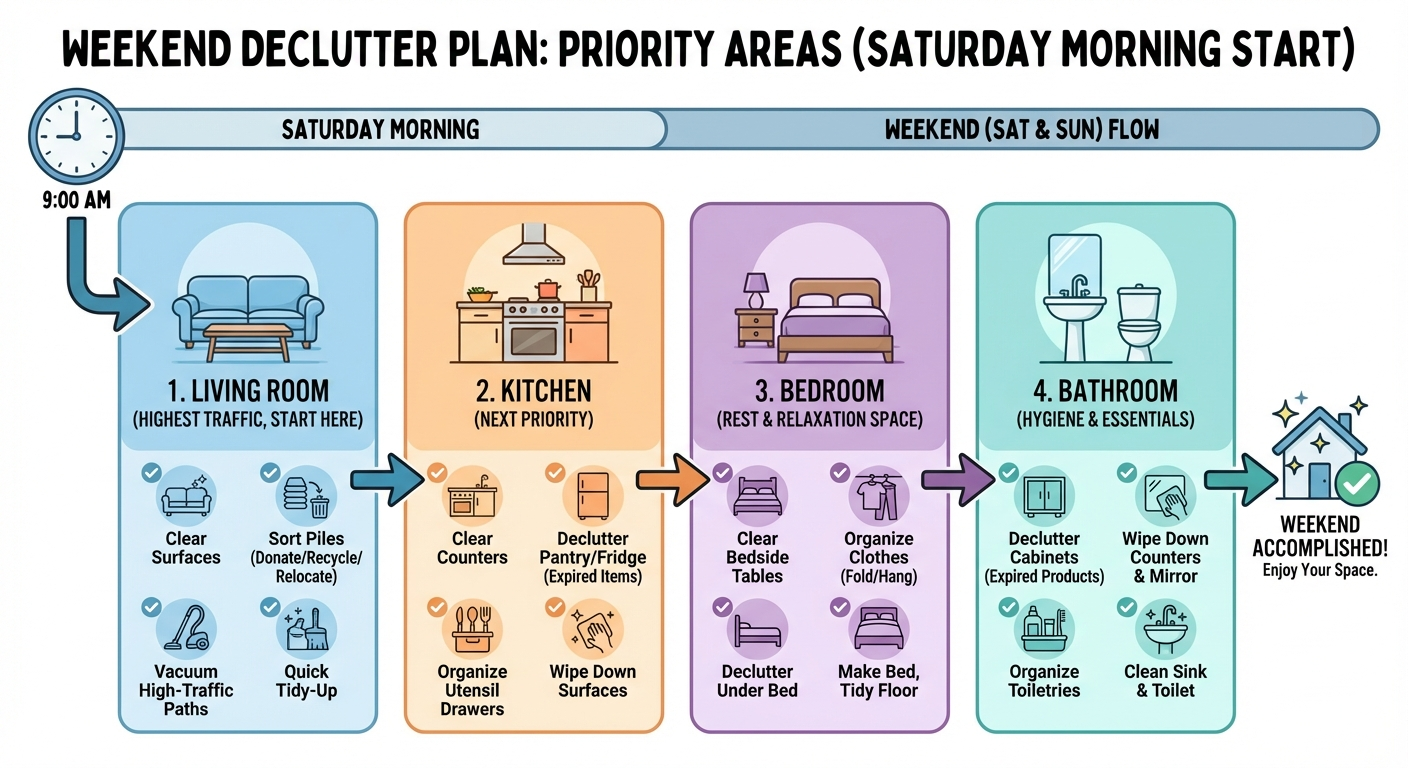
This schedule is based on an average three-bedroom home. If your home is smaller, you will finish ahead of schedule. If it is larger, extend Sunday by two hours or defer one low-priority room to the following weekend.
Saturday: The Heavy Lifting
| Time Block | Room | Estimated Duration |
|---|---|---|
| 8:00 – 10:30 AM | Living Room and Entryway | 2.5 hours |
| 10:30 – 10:45 AM | Break | 15 minutes |
| 10:45 AM – 1:00 PM | Kitchen and Pantry | 2.25 hours |
| 1:00 – 2:00 PM | Lunch Break | 1 hour |
| 2:00 – 4:30 PM | Home Office or Junk Room | 2.5 hours |
| 4:30 – 5:00 PM | Bag and label all Donate and Trash items | 30 minutes |
| 5:00 – 6:00 PM | Load car with donations and take trash to kerb | 1 hour |
Saturday evening: Rest. Do not attempt another room. Your decision-making energy is spent. Watch a film, order food, and go to bed early.
Sunday: Finish and Maintain
| Time Block | Room | Estimated Duration |
|---|---|---|
| 8:00 – 11:00 AM | Primary Bedroom and Wardrobe | 3 hours |
| 11:00 – 11:15 AM | Break | 15 minutes |
| 11:15 AM – 12:30 PM | Bathroom(s) | 1.25 hours |
| 12:30 – 1:30 PM | Lunch Break | 1 hour |
| 1:30 – 3:00 PM | Children's Rooms or Guest Room | 1.5 hours |
| 3:00 – 4:00 PM | Garage, Laundry, or Utility Spaces | 1 hour |
| 4:00 – 5:00 PM | Final walkthrough and donation drop-off | 1 hour |
The schedule works in 45-minute sprints with 15-minute breaks. Research from the Draugiem Group's productivity study found that the ideal work-to-rest ratio is approximately 52 minutes of focused work followed by 17 minutes of rest. We round that down to 45/15 because decluttering is physically demanding.
The 4-Box Method Explained

The 4-box method is the backbone of this entire weekend. It forces a single, immediate decision on every object you pick up. Here is how it works:
Box 1: Keep
This item is used regularly (at least once in the past 12 months), is in good working condition, and has a clear home in the room you are currently decluttering. If it passes all three tests, it stays.
Box 2: Donate
The item is in good condition but you no longer use it, need it, or love it. This includes clothing that no longer fits, duplicate kitchen gadgets, books you will not re-read, and toys your children have outgrown. If someone else could benefit from it, it goes in the Donate box.
Box 3: Trash
The item is broken, expired, stained beyond repair, missing parts, or otherwise unusable. Do not donate broken items — charities spend significant resources disposing of unsellable donations. Be honest and bin it.
Box 4: Relocate
The item belongs in your home, but not in the room you are currently sorting. A hairbrush found in the kitchen goes in the Relocate box. At the end of each room, walk the Relocate box through the house and place each item in its correct room. Do not stop to organise those rooms yet — just drop the items off.
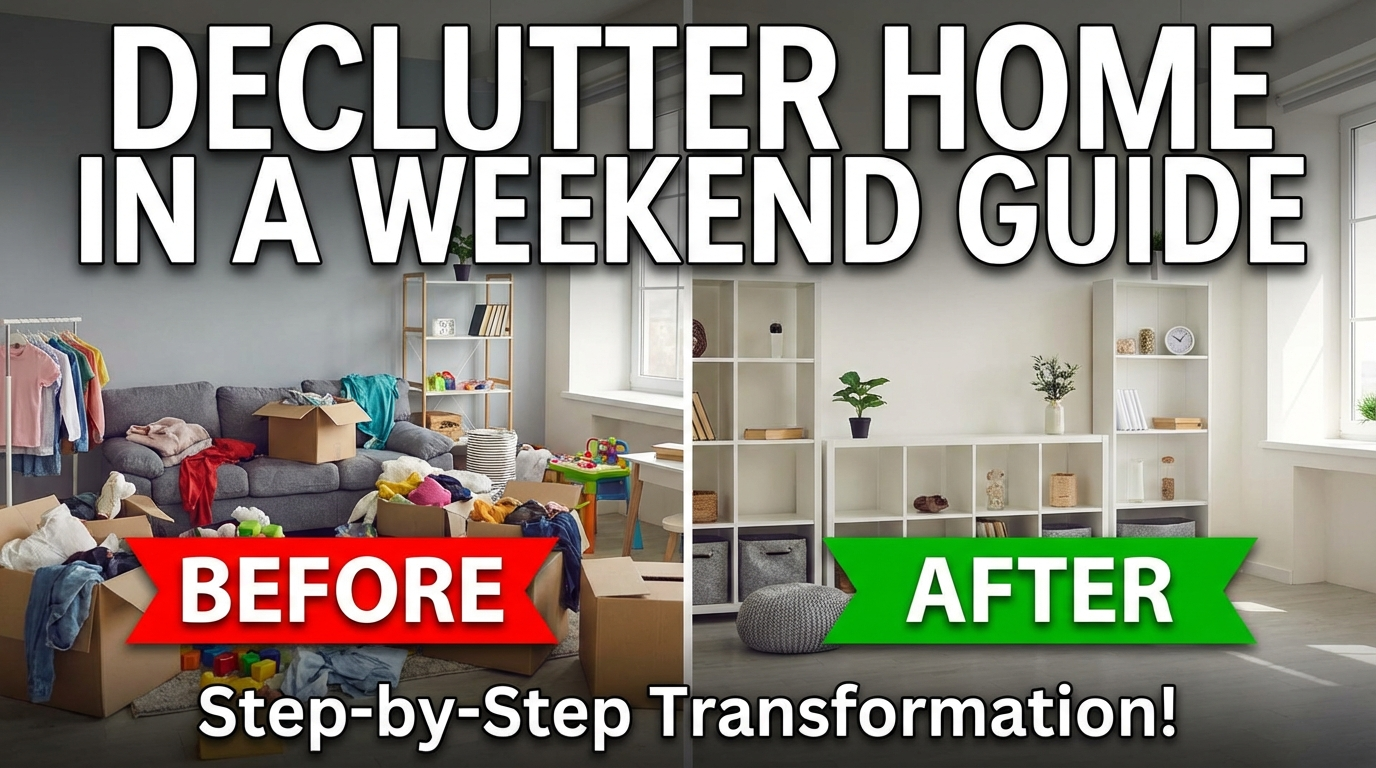
The One-Touch Rule
Every item gets picked up once and placed directly into one of the four boxes. You never put it back on the shelf to "decide later." Indecision is the enemy of progress. If you genuinely cannot decide, use the 90-day sealed box trick: place the item in a separate sealed box, write the date on it, and store it out of sight. If you have not opened the box in 90 days, donate it without looking inside.
Room-by-Room Decluttering Guide
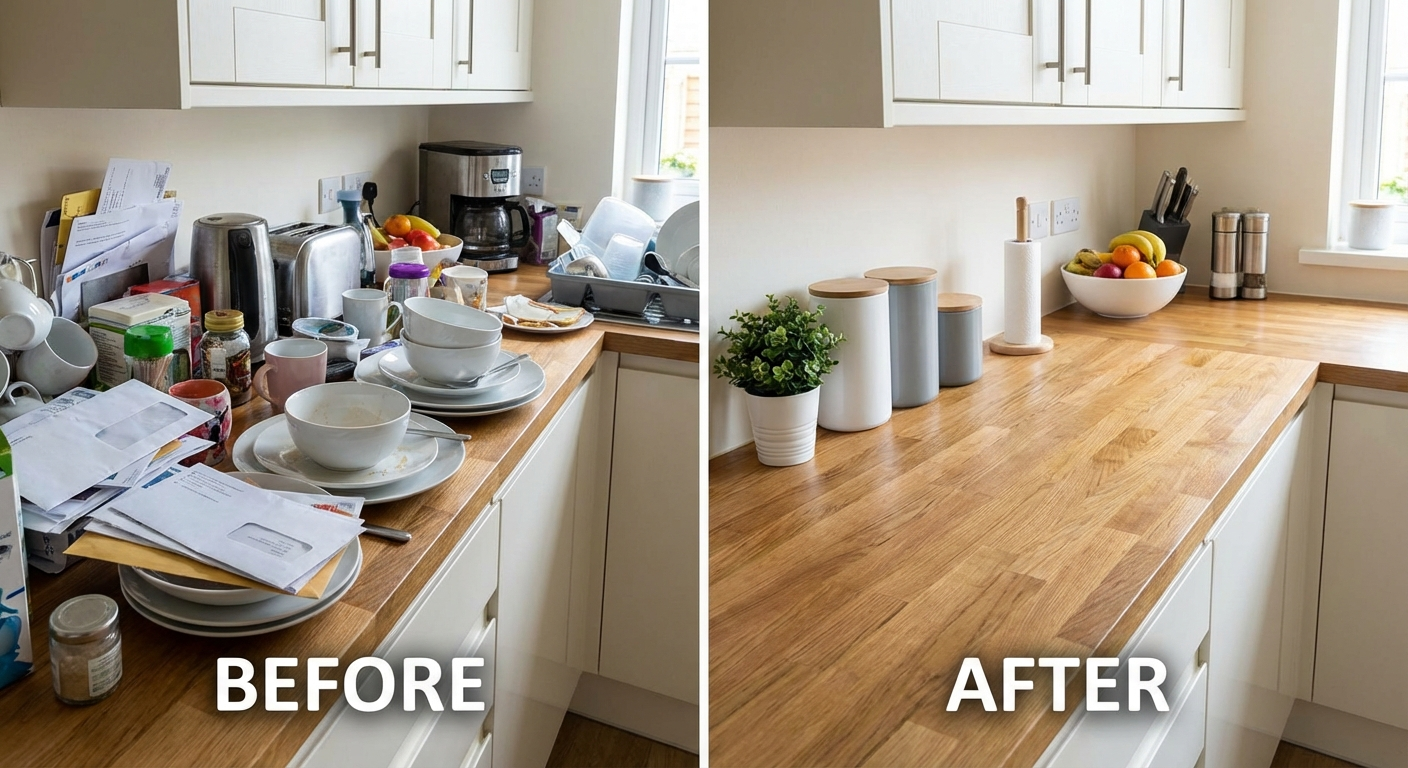
Living Room and Entryway (Saturday Morning)
The living room is your most visible space, so starting here gives you an immediate morale boost. Focus on these clutter hotspots:
- Coffee table and side tables — remove everything, wipe down, and return only items you use daily (remote, coaster, one decorative item)
- Magazine and paper pile — recycle anything older than one month; scan important documents to your phone
- Entertainment centre — discard tangled cables, old DVDs, and instruction manuals for electronics you no longer own
- Entryway — limit coat hooks to one jacket per person; remove shoes that have not been worn in 6 months
- Bookshelves — remove books you have read and will not reference again; donate to your local library
Pro tip: Place a "landing strip" tray near the door for keys, wallets, and sunglasses. This one addition eliminates the daily "where are my keys" search that wastes an average of 10 minutes per week according to a Pixie lost-item survey.
Kitchen and Pantry (Saturday Midday)
Kitchens accumulate clutter faster than any other room because they are high-traffic spaces with constant consumable turnover. Work through these zones in order:
- Countertops — clear everything. Only return items you use daily: coffee maker, kettle, toaster, knife block. Everything else gets a cabinet home.
- Under the sink — discard expired cleaning products. Consolidate duplicates. You do not need four bottles of surface spray.
- Pantry — check expiration dates on every item. Group remaining food into categories: grains, canned goods, snacks, baking supplies.
- Tupperware drawer — match every container to its lid. Orphaned lids and warped containers go in the trash.
- Utensil drawer — remove duplicates and single-use gadgets. If you own three spatulas and a melon baller you have used once, keep one spatula and bin the baller.
- Spice rack — ground spices lose potency after one year. Check dates and replace as needed.
Home Office or Junk Room (Saturday Afternoon)
Every home has that one room that becomes a dumping ground. This is often the hardest room emotionally but the most rewarding to complete.
- Paper — shred anything with personal information that is older than seven years (tax records) or one year (bank statements). Scan and store digitally if needed.
- Cables and tech — be ruthless. If you cannot identify what a cable charges, recycle it.
- Craft and hobby supplies — keep supplies for hobbies you have actively done in the past six months. Donate the rest.
- Miscellaneous — this room often holds items that belong elsewhere. The Relocate box will see heavy use here.
Primary Bedroom and Wardrobe (Sunday Morning)
The bedroom should be a calm, minimal space. Remove everything from surfaces — nightstands, dressers, windowsills — and only return essentials. See the detailed wardrobe section below for clothing-specific guidance.
Bathroom(s) (Sunday Late Morning)
Bathrooms are quick wins because the decisions are straightforward:
- Medicine cabinet — discard all expired medications (take to a pharmacy for safe disposal), dried-out cosmetics, and nearly empty bottles
- Under the sink — consolidate half-used shampoo bottles; discard travel-sized products you took from hotels years ago
- Towels — keep two sets per person plus one guest set. Donate excess towels to an animal shelter
- Shower — limit to one shampoo, one conditioner, and one body wash per person in the shower at a time
Children's Rooms (Sunday Afternoon)
Involve children aged five and older in the process. Give them their own smaller version of the four boxes and let them make decisions about their own toys. For younger children, declutter while they nap or after bedtime.
- Toys — use the "one bin" rule: if it does not fit in the designated toy bin, something must leave
- Clothing — children outgrow clothes rapidly. Check fit on everything and donate what no longer works
- Art and schoolwork — keep a small portfolio of the best pieces; photograph the rest and create a digital album
Garage and Utility Spaces (Sunday Afternoon)
The garage is last because it is the least emotionally charged. Most items here are purely functional.
- Seasonal items — consolidate into clear, labelled bins. Ziploc Space Bags reduce bulky bedding and winter coats to half their volume.
- Tools — keep one of each type. Donate duplicate hammers, screwdrivers, and wrenches.
- Paint cans — if the paint has separated or the lid is crusted shut, it is dead. Take it to a hazardous waste collection point.
- Sports equipment — if nobody has used that tennis racket or yoga mat in two years, donate it.
Best Decluttering and Storage Products
Once you have decluttered, the right storage products keep your newly organised spaces functional. Here are the products our team uses and recommends:
<div style="display:grid;grid-template-columns:repeat(auto-fit,minmax(280px,1fr));gap:1.5rem;margin:2rem 0;"> <div style="border:1px solid #e2e8f0;border-radius:12px;padding:1.5rem;background:#f8fafc;">IRIS USA Stackable Storage Boxes
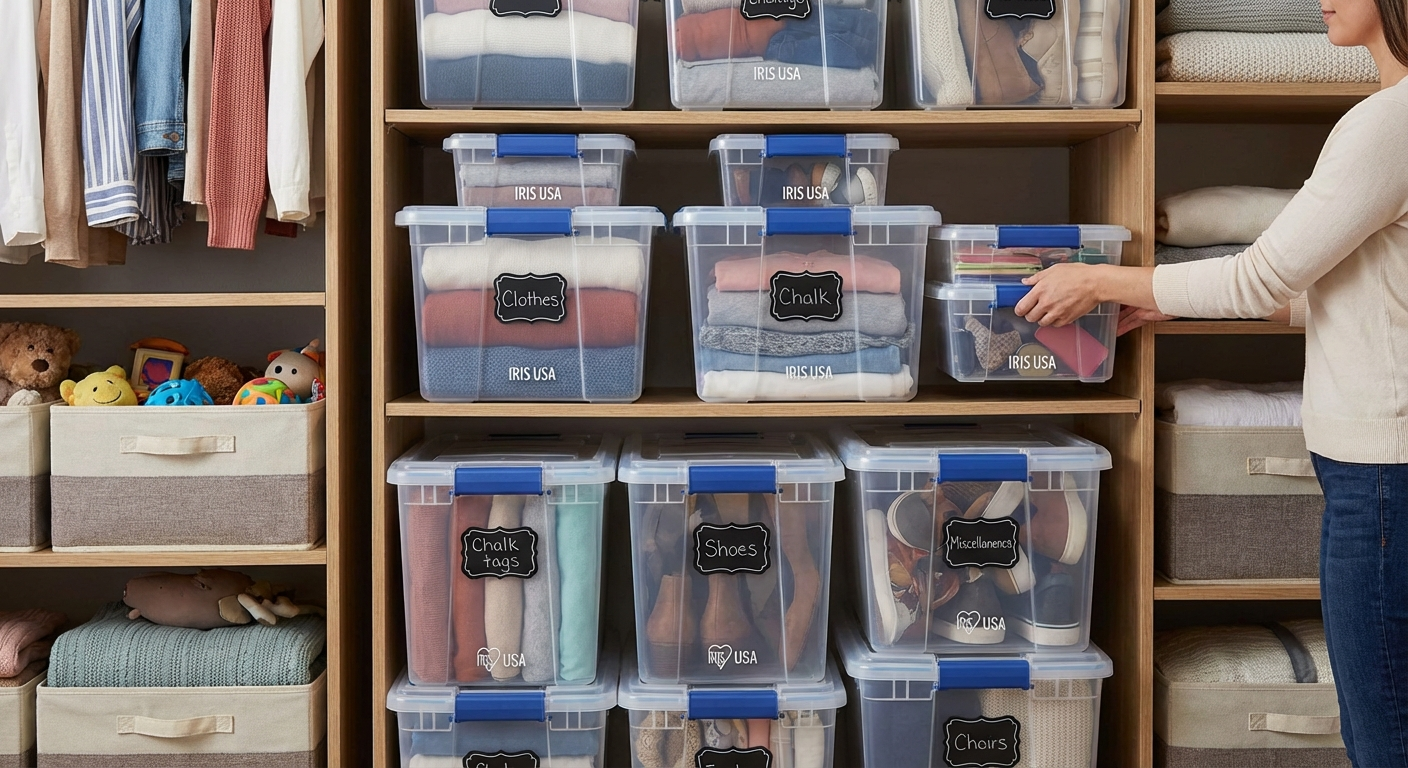
Clear, stackable, and available in multiple sizes. These are the gold standard for pantry, garage, and closet organisation. The snap-tight lids keep dust and pests out. We use the 32-quart size for seasonal clothing and the 12-quart for pantry dry goods.
Best for: Pantry, garage, closets
</div> <div style="border:1px solid #e2e8f0;border-radius:12px;padding:1.5rem;background:#f8fafc;">Ziploc Space Bag Vacuum Storage
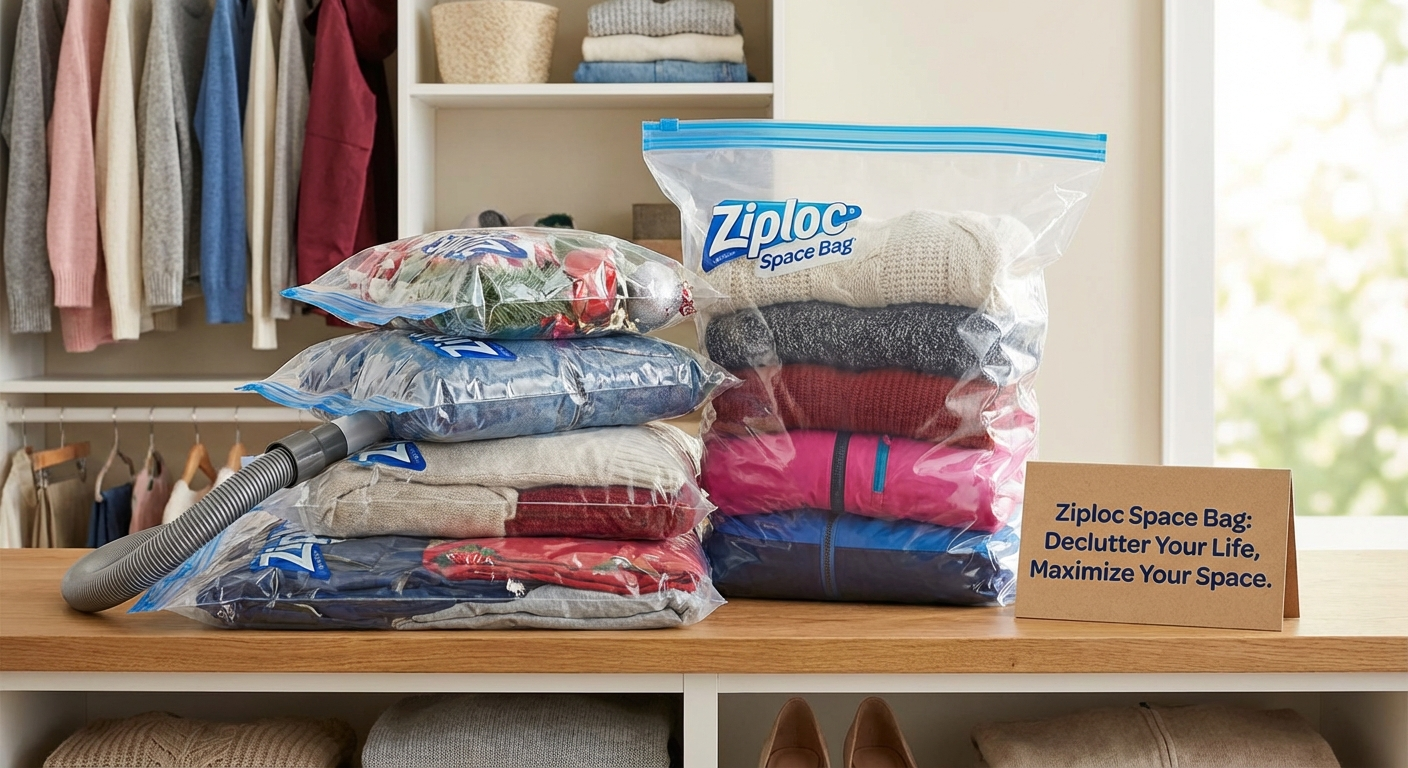
Vacuum-seal bags that compress bulky items like comforters, pillows, and winter coats by up to 75 percent. Use any household vacuum to remove the air. Essential for small apartments and homes with limited closet space.
Best for: Seasonal clothing, bedding, coats
</div> <div style="border:1px solid #e2e8f0;border-radius:12px;padding:1.5rem;background:#f8fafc;">Command Hooks and Strips
No-damage adhesive hooks and strips turn unused wall and door space into functional storage. Use them behind closet doors for bags, scarves, and belts. Behind the bathroom door for robes and towels. Inside cabinet doors for measuring cups and pot lids.
Best for: Bathrooms, closets, kitchens
</div> <div style="border:1px solid #e2e8f0;border-radius:12px;padding:1.5rem;background:#f8fafc;">DYMO LetraTag Label Maker
Labelling is the habit that separates a weekend declutter from a lasting transformation. A label maker removes ambiguity about where items belong and helps every household member maintain the system. The DYMO LetraTag is affordable, portable, and uses standard label tape.
Best for: Pantry, bins, shelves, drawers
</div> </div>Recommended reading: Marie Kondo's The Life-Changing Magic of Tidying Up remains the definitive text on the emotional and philosophical approach to decluttering. Even if you do not follow the full KonMari method, the mindset chapters are invaluable.
For a comprehensive list of storage solutions after your declutter weekend, see our roundup of the best home organization products.
30-Second Video Summary
Watch a quick visual overview of the weekend battle plan, the 4-box method, and the long-term maintenance habits that keep your home clutter-free.
<video autoplay muted loop playsinline poster="/images/articles/how-to-declutter-home-in-a-weekend-video-thumb.jpg" style="width:100%;border-radius:8px;margin:1.5rem 0;"><source src="/videos/how-to-declutter-home-in-a-weekend-demo.mp4" type="video/mp4"></video>
Your Wardrobe: A Detailed Deep-Dive

The wardrobe is the single most emotionally charged area of a home declutter. Clothing carries identity, aspiration, and memory in ways that kitchen gadgets and old magazines do not. Here is a systematic approach that respects the emotional weight while maintaining momentum.
Step 1: Empty Everything
Remove every item from your wardrobe, dresser drawers, and any under-bed clothing storage. Pile it all on the bed. Yes, all of it. Seeing the total volume of clothing you own is the most powerful motivator to let things go.
Step 2: Sort by Category, Not Location
Do not sort by wardrobe section. Instead, group all items into categories:
- Tops (T-shirts, blouses, sweaters)
- Bottoms (trousers, jeans, shorts, skirts)
- Dresses and jumpsuits
- Outerwear (coats, jackets)
- Active and loungewear
- Undergarments and socks
- Accessories (scarves, belts, hats)
- Shoes
Step 3: Apply the Declutter Tests
For each item in each category, ask these questions in order:
- Does it fit right now? Not "will it fit when I lose ten pounds." Right now, today. If no, it goes.
- Is it in good condition? Stains, holes, pilling, broken zippers — if you would not buy it in this condition at a charity shop, donate or trash it.
- Have I worn it in the past 12 months? Exception: formal wear you genuinely need once or twice a year.
- Do I feel confident wearing it? If you always skip over it, that is your answer.
Step 4: Organise What Remains
For detailed guidance on the best wardrobe systems to organise your remaining clothes, read our guide to the best closet organizer systems.
Once you have your keep pile, organise it back into the wardrobe using these principles:
- Hang structured items — blazers, dress shirts, coats, dresses
- Fold heavy knits — sweaters stretch on hangers; fold and stack on shelves
- Use drawer dividers — for undergarments, socks, and small accessories
- Face all hangers the same direction — after six months, turn around any hanger you have not touched. Those items get donated at the next seasonal review.
- Sort by colour within categories — this is not just aesthetic. It prevents you from buying duplicates of the same navy T-shirt.
The Capsule Wardrobe Shortcut
If you want to go further, consider building a capsule wardrobe: 30 to 40 versatile pieces that mix and match across all occasions. A capsule wardrobe eliminates decision fatigue, reduces laundry volume, and makes getting dressed a 2-minute task instead of a 15-minute ordeal.
Staying Clutter-Free Long-Term
A weekend declutter is transformative, but it is only the beginning. Without maintenance habits, clutter returns within three to six months. Here are the five habits that prevent regression:
1. The One-In-One-Out Rule
Every new item that enters your home triggers the departure of one existing item. Buy a new pair of shoes? An old pair goes to donation. Receive a birthday gift? Choose something of similar size to let go. This rule alone prevents net accumulation.
2. The 15-Minute Monthly Purge
Set a recurring calendar reminder for the first Saturday of each month. Spend exactly 15 minutes on one drawer, shelf, or cabinet. Rotate through a different area each month. Over 12 months, you will have reviewed your entire home without ever needing another full weekend declutter.
3. The "Does It Have a Home?" Test
Before putting something down, ask: does this item have a designated home? If not, either assign it one immediately or accept that it does not belong in your house. Items without homes become clutter within days.
4. Digital Declutter Counts Too
Apply the same principles to your digital life. Unsubscribe from emails you never read. Delete apps you have not opened in 90 days. Clear your downloads folder monthly. Digital clutter creates the same cognitive load as physical clutter, according to research from the Princeton Neuroscience Institute.
5. Build the Habit
Consistency matters more than intensity. If you struggle to maintain decluttering routines, consider building a daily declutter habit using a habit tracker. Even five minutes daily is more effective than an annual purge.
For more creative strategies in compact living spaces, explore our small space organization ideas.
Frequently Asked Questions
How long does it really take to declutter a whole house?
Most homes between 800 and 2,000 square feet can be decluttered in a single weekend — roughly 12 to 16 active hours — using a structured room-by-room approach. Larger homes or severe clutter situations may require a third day or a second weekend. The key is maintaining momentum and avoiding the temptation to deep-clean as you go.
What is the 4-box method for decluttering?
The 4-box method uses four labelled containers — Keep, Donate, Trash, and Relocate — to force a single decision on every item you touch. It prevents the common habit of shuffling clutter from one room to another and keeps the process moving at a steady pace.
Should I clean as I declutter or wait until the end?
Wait until the end. Decluttering and cleaning are separate tasks, and mixing them slows you down significantly. Complete your full declutter first, then do a cleaning pass on Sunday evening or the following week. You will clean faster anyway because there are fewer items to move around.
What should I do with items I cannot decide on?
Place undecided items in a sealed box labelled with today's date. Store it in a closet or garage. If you have not opened the box after 90 days, donate its contents without looking inside. This approach respects your uncertainty while preventing indefinite accumulation.
How do I stop clutter from coming back after a weekend declutter?
Adopt the one-in-one-out rule: every new item that enters your home means one existing item leaves. Combine this with a monthly 15-minute quick purge of one drawer or shelf to maintain your results permanently.
Is it better to declutter alone or with help?
Having one helper speeds up the process by roughly 40 percent. Choose someone who will respect your decisions without pushing you to keep or discard items. Avoid inviting more than two helpers, as too many opinions create decision fatigue and slow progress.
Conclusion
Decluttering your entire home in a weekend is not a fantasy — it is a plan. By preparing your supplies on Friday evening, following the Saturday-Sunday room schedule, and using the 4-box method to force immediate decisions, you can transform your living space in approximately 14 hours of focused work.
The physical transformation is just the beginning. Clients consistently report reduced stress, better sleep, and an unexpected sense of control after a successful declutter weekend. The spaces you clear are not just physical — they are mental.
Start this Saturday morning with the living room. Set your timer for 45 minutes. Grab your four boxes. And begin.
Sources and Methodology
- National Association of Productivity and Organizing Professionals (NAPO) — Industry data on time lost to disorganisation and professional organiser best practices.
- KonMari Method — Marie Kondo's category-based approach to decluttering, adapted for a weekend timeframe.
- Princeton Neuroscience Institute — Research on the cognitive effects of physical and digital clutter on focus and stress levels (McMains & Kastner, 2011).
- Draugiem Group Productivity Study — Data on optimal work-rest intervals, applied to our 45/15-minute sprint schedule.
- Pixie Lost and Found Survey — Statistics on average time spent searching for lost items in cluttered homes.
- Professional experience — Recommendations informed by over 200 client home declutter projects completed by Jamie Chen since 2019.
Jamie Chen is a Certified Professional Organizer (CPO) and KonMari Consultant based in Philadelphia. She has helped over 200 families declutter and organise their homes since 2019. When not sorting other people's possessions, she maintains a 40-piece capsule wardrobe and a ruthlessly curated bookshelf. Contact Jamie at our contact page.